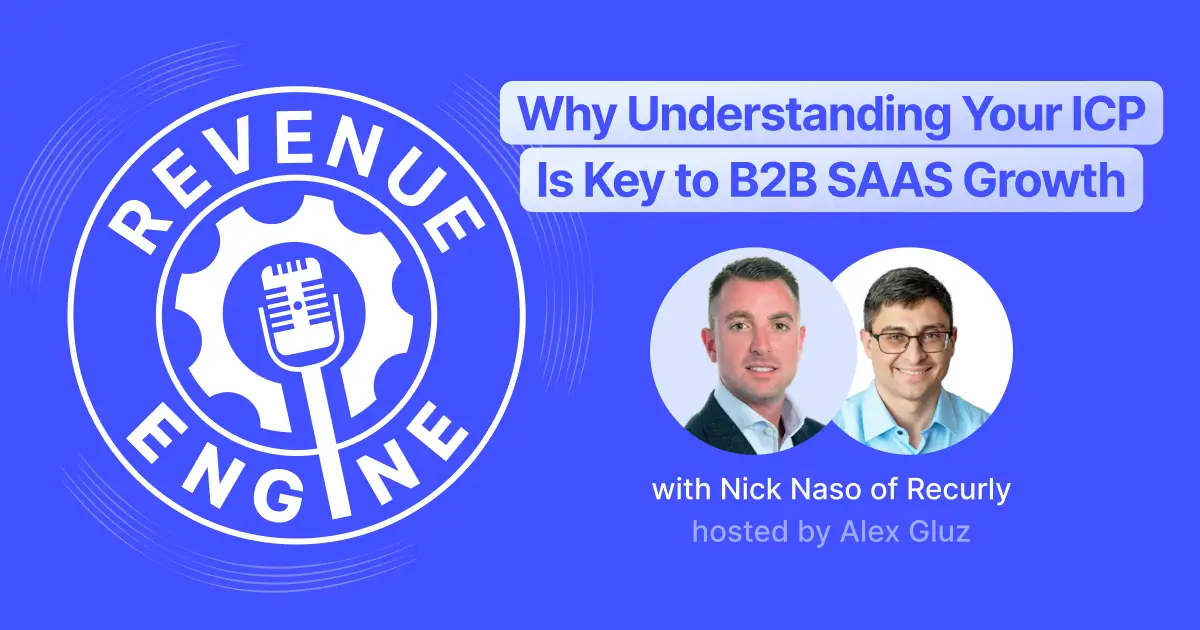
Introduction and Nick Naso’s path into sales
Alex Gluz: We have a great guest for you today. Super excited. Nick, nice to have you here.
Nick Naso: Alex, great to be here. I think every SaaS organization is looking for more leads, so great sponsor. Thanks.
Alex Gluz: Can you do a brief intro of who you are and what you do?
Nick Naso: Sure. Nick Naso. I’m the Chief Revenue Officer at Recurly. Recurly is a subscription management and billing provider. We’re the platform that helps subscription businesses grow and scale their revenue.
Nick Naso: I’ve been at the business just over two years, based in Atlanta, Georgia. I do a ton of travel back to our Austin and Denver offices.
Alex Gluz: How did you get started? What did you go to school for?
Nick Naso: Ironically, I was actually a political science major. I had the idea of being a sports agent, so I wanted to go to law school.
Nick Naso: I ended up at Florida State University. Went there, decided I wanted to go to law school, took the LSAT and everything, and then realized I’m not ready to do school for another three years.
Nick Naso: I pivoted and said, “All right, I’m not going to do that. What am I going to go do?” I didn’t know what I was going to go do, so I ended up taking a sales job and got into sales.
Nick Naso: Actually, not too far from you. I think you’re in Boca Raton, right? I worked for a business by the name of City Furniture and got into their sales management training program. I did that for some time before I moved up to Atlanta, which is where I’m at now.
Nick Naso: I never went back to law school or went towards that passion. Got into sales, and it’s a hard thing to get out of once you get in.
Alex Gluz: I looked at your career, and we chatted briefly. You’re a sales guy. That’s who you are. That’s what runs in your blood. That’s what you do.
Alex Gluz: I love sales too. It’s always intrigued me, marketing and sales, and obviously running the business, you need to do sales.
Alex Gluz: One question always intrigued me: why do they not teach sales at university or higher education? What is your take on that?
Nick Naso: That’s a good question. Why do they not teach sales? I would ask the same question as why don’t they teach personal finance in K-12? That’s another one of those questions.
Nick Naso: Sales is one of those things that everybody does, whether they know it or not. It’s a part of every role or job that you’re going to have in your life. Consultants are salesmen. Lawyers are salesmen. You name it, you’re in sales.
Nick Naso: Good question. I don’t know why they don’t. Some institutions of higher education do teach it, and it is a specialization within business. But to your point, I think it’s few and far between.
Nick Naso: There are so many methodologies. I’ve never thought about it, and I honestly don’t have a good answer for you.
Alex Gluz: I did some research before, and I always was wondering about this. I ran it through ChatGPT, and the answers it gave me honestly made no sense whatsoever.
Alex Gluz: They did the research, and they gave me the answer, “It’s considered to be vocational. It’s like a trade,” and things like that.
Alex Gluz: That makes no sense. They said within the last 15 years, the number of universities offering sales went from nine to 237 in the whole world, which made no sense.
Alex Gluz: I don’t know if you ever read the book The Science of Selling. I think he touches on that. It’s quite interesting. I believe it was him, and he said in the 1930s they were offering this at a bigger scale, and it was really a program.
Alex Gluz: Once marketing became more popular and more money started to pump into this, they transitioned everything to marketing and more at scale.
Alex Gluz: It’s always been such an interesting thing. It’s such an important job, also a very well-paid job if you do it the right way, but there is no formal education, really.
Nick Naso: There’s not. You’re right. I follow a number of different sales publications and influencers and minds on social media, whether it’s X or Instagram or what have you.
Nick Naso: Talk about being well paid if you’re willing to put in the work. I do think it’s ever-evolving. Quite frankly, there are some core elements of it that are never going to go away, but as the market evolves, so do sellers have to evolve as well.
Nick Naso: Like everything, you just have to evolve with the times and continue to educate yourself, whether that’s through the company you work for or being self-taught. I think it’s always a combination of both.
Why Nick joined Recurly
Alex Gluz: We’re really excited to chat with you, and it’s always very interesting to me to get perspective from sales folks.
Alex Gluz: You’ve had a long and successful career in sales, but a few years ago you joined Recurly. What attracted you to Recurly?
Nick Naso: A few things. Number one was the way I got in touch with Recurly, and that was through somebody who I had worked with previously, who was an executive leadership coach at a private equity firm.
Nick Naso: I had known her for years, almost 20 years, and went through a program that she led. She put me in touch with some folks, so there was some trust already built there. That was number one.
Nick Naso: Number two, I thought the space was really interesting. Subscriptions are interesting because I am a consumer of subscriptions. Anytime that you can connect with what you’re selling, I think it’s better.
Nick Naso: I really enjoyed the space. It’s an exciting space and a growing space.
Nick Naso: Third, the people were fantastic. My interview process was fantastic. Coming out of the pandemic, I traveled for the interview, got to meet the folks I’d be working with, and I think that was great.
Nick Naso: The last piece of it, as somebody who’s going to lead sales and revenue for any business, that part is really important to you, or at least to me.
Nick Naso: Over the years, what I’ve found to do is do my due diligence in other areas of the business: engineering, product, customer success, onboarding, post-sale. There are a number of different cross-functional areas that have a significant impact on how successful you can be in sales and revenue.
Nick Naso: What I was excited about was how solid a company Recurly was. As I think all of us sales folks have, we have a little bit of an ego, and we’re like, “Well, yeah, we could go sell more.”
Nick Naso: If the foundation is built, let me at it. I think that was the mindset I had. It was a combination of all those things, and it’s been reinforced every day since I joined.
Moving from individual contributor to revenue leader
Alex Gluz: Sounds like a great company and a great fit for you.
Alex Gluz: What do you think about the transition from being a salesperson, just responsible for your quota, for your activities, then becoming a sales manager, then becoming a sales leader?
Alex Gluz: Now the next step is Chief Revenue Officer, where you have an even broader scope. You need to see an even fuller picture of everything because revenue is so many different areas.
Alex Gluz: With sales, once you sell something, there is a certain point you stop and hand this over. You might still have oversight, but what was your journey like? Maybe you can share some insights.
Nick Naso: My journey was kind of on accident, quite frankly. I happened to have an individual who I worked with. He was our VP of Sales, head of sales for the company I was with at the time.
Nick Naso: We had worked well together, and he said, “Hey, I’ve got an opportunity for you.”
Nick Naso: It actually started to get into more alliance management and channel management, managing a large strategic partner. I eased into it in a way that was individual contributor into alliance and partnership management, which was more of a matrix.
Nick Naso: Quite frankly, that’s actually a little bit more difficult in a way because those resources don’t technically report up through you. It’s more influence and partnership than it is direct-line management.
Nick Naso: Then from there, into direct first-line sales management. I had a little bit of a transition, and it wasn’t quite individual to manager.
Nick Naso: That role for me really helped me, to your point, open up and see the scope of the business and all the different functions and areas, and how they are involved and impact sales.
Nick Naso: On the flip side, just in general, everybody individually has to understand what their motivators are and has to be honest with themselves on what those motivators are.
Nick Naso: If you want to go make money and you want to deal with as few people as possible, stay an individual contributor.
Nick Naso: I had a friend of mine who lives in the Philly area. He was in sales management, got out of it, and was interested in pursuing another role. We were talking about compensation and his goals, and I said, “Hey, stay. Don’t move.”
Nick Naso: At a lot of businesses, the best individual contributor is making more than anybody else at the company.
Nick Naso: Be honest with yourself. Do you want to mentor? Do you want to coach? Do you want to do all those things?
Nick Naso: That’s the first step before just assuming that being a manager, being a VP, being a CRO is the goal because it sounds good. That’s definitely not the answer.
Nick Naso: You’ve got to want to do it. If you want to do it, there are tons of different avenues that you can develop your skill set and get to that point.
Nick Naso: Being honest with yourself and your motivators is the first step.
Adapting the sales team and staying close to customers
Alex Gluz: That’s great advice, and it’s part of education and experience and being hands-on.
Alex Gluz: When we chatted before, Nick, you mentioned that the real change at Recurly came from shifting the team, not just the product. When did you realize that the change in the team dynamics was more critical than the product overhaul for driving revenue growth?
Nick Naso: It came after, I would say, the 90-day mark. Not because it’s cliche, but that’s about the time, maybe a little bit earlier. It took a little while to put the changes into place.
Nick Naso: At the end of the day, it’s really rolling up your sleeves and getting into the weeds and understanding what’s happening in the field, for lack of a better term.
Nick Naso: Listening to Gong calls, joining calls yourself, digging into the pipeline and understanding the attributes of the account, and really understanding the business.
Nick Naso: The worst thing that a new leader can do is come in and make change for the sake of making change, or making change based on change they’ve made in the past.
Nick Naso: It helps inform the change you might make and know what questions to ask and what things to look for. But really understanding where the business is.
Nick Naso: For us, it was understanding that we were moving upmarket. Our buyers and folks who were interested in Recurly and were having success with Recurly were businesses that were larger than we were used to doing business with.
Nick Naso: There’s a reason at many companies that there are different tiers of sellers, meaning folks who focus on SMB, folks who focus on mid-market, enterprise. There’s a certain skill set inherent in each of those folks.
Nick Naso: We needed folks who had the skill set to sell into the mid-market, enterprise businesses, and we just didn’t have it.
Nick Naso: It wasn’t that they were not the right sellers. It was that they weren’t the right sellers for Recurly at the time. For me, everything comes down to fit.
Alex Gluz: That’s really good, to have this vision and understand that the dynamics are shifting. You need the right resources for the right times and the right opportunities.
Alex Gluz: It’s not necessarily that anybody’s doing anything wrong. It’s just change, and you need to adjust and adapt.
Alex Gluz: Nowadays, are you still pretty hands-on? What’s your philosophy about being hands-on, and when do you try to get on a call to talk to customers? How do you plan this?
Nick Naso: I actually had a call with a customer earlier this morning, and it was a sales call. The good old adage of “it depends.”
Nick Naso: I’ll say consistently that I want to keep my pulse on things as much as possible. I’m fortunate in that I have some really good leaders. My VP of Sales in North America is very good, in addition to some other leaders.
Nick Naso: At the end of the day, I still want to listen to Gong calls on a weekly basis. I still want to jump on customer and prospect calls on a weekly basis.
Nick Naso: I’m involved in forecasting and pipeline reviews, understanding what’s coming inbound, where we’re having success. There’s context in everything.
Nick Naso: Understanding the context helps you understand how to adjust and make decisions for the future. I still want to be in the weeds to an extent. Not every day, but it helps me with context and decision-making.
Alex Gluz: I totally agree. Sometimes, being in this position and having so much experience, you can be on the call and pick up intricate, small details.
Alex Gluz: The way people phrase something, or they say something, and you can pick this up, and that can change the whole context of the conversation. Somebody might not even pick this up.
Alex Gluz: It’s also great to have this support and leadership.
Nick Naso: To your point, Alex, it’s another set of eyes and ears where you’re hearing something different.
Nick Naso: Because somebody’s so engaged or involved in the conversation, they miss that slight change of tone or that slight eye roll that somebody wasn’t paying attention to, or somebody else who was on the screen.
Nick Naso: Those things matter in calls. Again, context is everything. Good point.
Keeping the ideal customer profile current
Alex Gluz: Another important thing you shared is how valuable and important your ICP is to your revenue strategy.
Alex Gluz: How often do you think companies should be evolving the ICP, especially as market conditions and customer behaviors change?
Nick Naso: I don’t want to say more valuable now than ever, because you can say that every day, because it’s always the case.
Nick Naso: Back to your earlier question about making some changes early on. One of the things that helped propel us the last couple of years was we were lacking a focus on our ICP. We had defined it, but we just lacked a focus.
Nick Naso: Anybody listening to this who is in a similar role knows that the more time you spend on prospects or customers outside your ICP, you’re probably not making the best use of your time. It was really digging into that.
Nick Naso: At a minimum, you’ve got to look at it on an annual basis. With how quickly this space, and I think all spaces, are changing, it’s got to be more than that. Probably twice a year.
Nick Naso: For us, we’re doing a formal reevaluation right now, and there are reasons behind that that are really fun and exciting, a couple of recent acquisitions.
Nick Naso: Even beyond that, we look at data on a monthly and a quarterly basis to understand our pipeline, our customers, our wins, characteristics and attributes of those accounts.
Nick Naso: All of that data is something that we look at ongoing so that we can adjust as necessary. You can’t wait for a more formal evaluation once or twice a year because it might be time to make adjustments, micro-adjustments, earlier on.
Nick Naso: It needs to be an evolving thing. With as quickly as things are moving in today’s day and age, you can’t afford to wait for a formal process.
Building revenue ownership across the company
Alex Gluz: That’s a great approach. You need to understand the requirements of today’s market and also of your business, seeing dynamics and continuously reviewing this.
Alex Gluz: Also, have more formal milestones to bring more people in, because then you’re going to bring more departments.
Alex Gluz: Speaking of which, as a CRO, and I’ve spoken to a few great CROs in the past, how does your company define this? What departments do you oversee, and how does it work?
Nick Naso: New-logo sales in the US and international, so global. Sales engineering, revenue operations, sales development, so SDR team, as well as renewals.
Nick Naso: We have a Chief Customer Officer. She joined just about a year ago and oversees the post-sale customer experience.
Alex Gluz: You’re working across many various functions, and you need to build a cohesive revenue strategy.
Alex Gluz: How do you ensure that every part of the organization, not just the sales team, feels accountable for revenue growth? How do you foster this revenue ownership mindset?
Nick Naso: I would be remiss if I said it was me. I’m obviously a big cog in that wheel, Alex, but at the end of the day, it starts with the entire executive leadership team.
Nick Naso: The executive leadership team has to buy into that. If they don’t, I could attempt to do as many things as I want to do, but they’re not going to stick.
Nick Naso: The team that we have is 100% bought into that. That starts at the top with our CEO, who is very much bought into that and builds that culture.
Nick Naso: Then it’s how do you act? It’s one thing to say. It’s another thing to actually go do. We do a really nice job of it.
Nick Naso: For instance, our weekly forecast meetings, we bring other functions into that. We have folks from all aspects of the business. Literally every function of the business has one or multiple representatives in that meeting to understand what’s going on.
Nick Naso: We do biweekly showcases, company showcases and company meetings, and we talk about it on those calls. We share successes.
Nick Naso: One of the things that’s really fun that we do is we recognize those outside of sales because we know that we don’t win on our own.
Nick Naso: If you talk to an engineer or somebody in product, the last thing they want to do is go build something that nobody uses.
Nick Naso: When they know that thing they built helped win a sale or make a customer happy, or is providing value for the market, they’re stoked about that. We want to call that out.
Nick Naso: We have formal awards on a quarterly, annual basis. Even in our Slack, we were talking about Slack when we first kicked off and that bittersweet tool, we have a sales wins channel.
Nick Naso: We make sure to call out everybody who was involved in the opportunity, not just the folks who owned it from a sales perspective.
Nick Naso: It’s really the culture, and the culture is the way you behave and act on a daily basis. That’s how you generate that cross-functional alignment so that everybody feels like they own revenue, because we do. We all do.
Subscription growth, personalization and flexibility
Alex Gluz: That’s a great approach, and that really shows why you’re so passionate about the company and so deliberate in your actions.
Alex Gluz: One of the interesting things you mentioned when we chatted was how subscription-based models can provide stability, especially during tough times like the pandemic, which seems like a long and not long time ago.
Alex Gluz: You said during the pandemic, the subscription business rose because that was one of the things that went up in demand.
Alex Gluz: What lessons from those times are you applying to your strategy today? Maybe you can talk in general for listeners. How did it work for your company in those times, and why do you think that happened?
Nick Naso: The pandemic was an interesting time. I’ll talk about the pandemic as a moment in time, but also about the future and what we learned from subscriptions then, how that’s evolved and then into the future.
Nick Naso: Subscriptions grew. Quite frankly, globally, in the US, everything was very regional. Depending on where you lived depended on how you were impacted.
Nick Naso: Some folks were able to live more of their typical life. I happen to live in Georgia. We were probably a little bit more open than others who might have lived in the Pacific Northwest, and things were still locked down for quite some time.
Nick Naso: Point being, digital media and entertainment grew substantially because it’s a relatively low-cost subscription on a monthly basis where it’s providing entertainment. People could gather.
Nick Naso: Even though it wasn’t a subscription, one of my favorite things was my teenage son and I, every Sunday night, got some ice cream, sat down and watched The Last Dance.
Nick Naso: It was an opportunity where entertainment and digital subscriptions were able to bring families together at a relatively low expense.
Nick Naso: Education was redefined in many ways by the pandemic, and having subscriptions to products like Zoom, it was more widely adopted. It really reshaped the way folks thought about how they engaged and communicated with others, and that has a big impact.
Nick Naso: Those services were really provided through the pandemic. Being a business that supports those businesses, naturally you’re going to get a lift over the coming years.
Nick Naso: What we see evolving is really personalization and flexibility. Those who subscribe to anything want their subscription to be personalized, and they want it to be easy and flexible to interact with.
Nick Naso: We’re seeing a lot of bundling, a lot of product swaps. They’re willing to pay for it because they want to pay for convenience.
Nick Naso: If you think about subscriptions, you probably subscribe to things that you either are really invested or interested in as an individual, and things that make your life convenient.
Nick Naso: If that’s the case, they’ve got to be very personable to you, and there’s competition everywhere.
Nick Naso: How do you keep me? You keep me by making it easy for me to do business with you and providing something that I see value in. I’m able to make that decision on my own and personalize my subscription.
Nick Naso: That goes across business-to-consumer, business-to-business. Frictionless experience and personalization and flexibility are the themes that we’re seeing.
New opportunities for subscription businesses
Alex Gluz: That’s an interesting point, and it’s an interesting conversation. I started to think about my personal subscriptions and my business subscriptions.
Alex Gluz: I do try to go over them and really evaluate what are we using, what are we not using. It’s definitely a trend that’s going to stay.
Alex Gluz: What do you think is the next big wave of subscription? Maybe something we still don’t see as subscription, just in general.
Alex Gluz: We saw this with technology and media and entertainment. We used to have Netflix. Now we have Paramount and Max, and on and on. There are probably 10 things, and Apple, and you have Apple Music, and you have this and you have that.
Alex Gluz: What do you think is the next big thing that is not a subscription right now, but you think is going that way?
Nick Naso: I’ll give a couple of different answers. It’s a subscription now, but more recently, and that’s health and wellness.
Nick Naso: That is an area that is just taking off. That’s from content, more fitness content, apps. That’s from vitamins. That’s from any type of health and wellness product.
Nick Naso: I see that as one that will continue to grow because people more and more are interested in their health and longevity like they’ve never been before. That’s a market that will continue to grow.
Nick Naso: I do think the automotive space and the hospitality space, and that gets into membership and loyalty.
Nick Naso: That will continue to be a place because it’s an area of opportunity for those types of businesses to grow and/or supplement a repeatable revenue stream from folks who want access.
Nick Naso: We went back to the personalization part and value. People value access and offers to brands that they value and enjoy. That’s an area that we will continue to see grow also.
Nick Naso: I do think transportation. When I say transportation or automotive, that could be not in the terms of a lease, but complementary solutions that are offered by automobile companies.
Nick Naso: It could be airlines. We’re seeing airlines come out with subscriptions more often. Recurly’s got a few customers in that space as well.
Nick Naso: We’re seeing more nontraditional businesses enter into the subscription market.
Evaluating vendors and adapting to informed buyers
Alex Gluz: That’s exciting. You make me think there are a lot of opportunities there. I’m sure a lot of companies would love to get into the subscription business and more predictable revenue. How do you get in? It’s an exciting time for you.
Alex Gluz: Another question I had, Nick, and this is more as a company leader, as a sales leader. You also come across tools and vendors you work with to supplement you.
Alex Gluz: How do you evaluate new sales or marketing tools or vendors before purchasing them?
Nick Naso: Good question. Talk about software evaluations, because we go through it on the other side. That’s what we experience on the sales side every single day. How are we doing it?
Nick Naso: It comes down to priority and value. For us, we always go back to what are our company priorities? What are we looking to do? How do we go do those and make those happen? How do we make it happen efficiently?
Nick Naso: Is there technology that can make our lives easier, more convenient, more efficient? Do they fit into that bucket, yes or no?
Nick Naso: From there, it’s documenting requirements. This is relatively basic, but documenting the requirements of what are the must-haves, what are the nice-to-haves.
Nick Naso: The area that I think is really interesting is, in 2025 and beyond, and it’s been going on for a few years, buyers are changing.
Nick Naso: They have more access. We, as a buyer in this instance, I’m putting myself in the buyer’s seat, have more access to data than we’ve ever had before.
Nick Naso: Whether that’s through AI, information on a website, YouTube, G2, you name it, we’ve got access to a ton of information.
Nick Naso: Buyers are showing up at your doorstep having more informed decisions or more data than they’ve ever had. They go to YouTube and watch demos without you even knowing. There’s a lot of access.
Nick Naso: It’s doing research before you even engage with whoever those folks are, and then engaging with them and understanding the type of business they are and where they are today, but then where they’re going.
Nick Naso: Is it somebody that we want to be in business with long term? There’s a balance with, can you solve my needs today, and are you somebody I can grow with into the future?
Alex Gluz: On the opposite side, that’s where the sales folks come in, real sales folks. They sell for the problem, not the need.
Alex Gluz: The need might be very small, but the problem could be bigger. People might not even understand the scale, scope of the problem and the impact.
Alex Gluz: That’s why you have salespeople, and you will need them. You can find the information, but if you don’t know what you’re looking for, you’re not going to be able to make the right decision.
Nick Naso: That’s a great point, Alex. The best really do that. They do that in a way that is, to what we were talking about, how do you add value and really understand the bigger picture?
Nick Naso: At the end of the day, that is what it’s all about.
Alex Gluz: Definitely. What do you think are the biggest pain points for B2B SaaS and tech leaders in 2025, and what is your approach to solving them?
Nick Naso: What we just talked about is the biggest one that I see. We can quote it as buyer behavior, but information and access to that information is just all over the place.
Nick Naso: In the past, there were more traditional routes to engage with the vendors that you wanted to evaluate. Formal RFPs, or there was just inbound, which still happens today.
Nick Naso: But the level across the spectrum of information and the maturity that everybody comes with is very different. It’s understanding where they are, meeting buyers where they are and understanding how to adapt based off that.
Nick Naso: You just said it, understanding the big picture. That’s always the case.
Nick Naso: Meeting them where they are, based on what information they come in with, what their problem is, when they want to do something, but really, how is it impacting their business?
Nick Naso: Every day, folks are being asked to cut budget or do more with less. How are you proving that you can do that, that you’re worth spending the money on?
Nick Naso: That’ll always be the case, but it’s even more so now than ever, especially with AI.
Nick Naso: That’s a big one. Those are the biggest that I see right now.
Alex Gluz: The buyer journey, cutting through the noise and being able to deliver the valuable information, showing the value and reducing the risk.
Alex Gluz: At the end, somebody’s making the decision, and they’re putting their faith in you, and they’re taking the risk. You want to show that we’re going to help you bring the value and reduce the risk.
Mentors, leadership lessons and closing remarks
Alex Gluz: Great advice. Nick, I have one last question for you. Who were your mentors, and the best advice they gave you?
Nick Naso: Mentors and the best advice they gave me. Good one. I’ve got a few.
Nick Naso: There are a couple of moments that have stood out in my career. I’ll share those, and I’ll go over mentors.
Nick Naso: I have a few mentors, and it actually goes back earlier in my career. If you look at my time at Surgical Information Systems, I had the fortune of working very closely with some great executives there.
Nick Naso: Our head of sales, our CFO, our CEO and our head of professional services. They were amazing mentors and really took me under their wing and showed me what success looked like.
Nick Naso: I grew up going to work with my dad on the weekends for fun. I thought it was cool. I loved the business that he was in and just listening to and watching him from afar.
Nick Naso: That also gave me the ability or the skill to observe others around me, even in an informal mentorship relationship. That had a very big impact on my career.
Nick Naso: I’m always watching and looking at what other leaders are doing and seeing how folks react to that and honing my skill and leadership accordingly.
Nick Naso: In one of my first sales jobs, I was killing it from a sales perspective, but I was missing this value-added service component.
Nick Naso: The general manager came up to me, put his arm around me, said, “Let’s take a walk.” He’s like, “Hey, you’re not going to get to go on the club trip. You’re hitting your numbers, but you’re missing these milestones here. You’ve got to hit these thresholds to qualify.”
Nick Naso: He said, “Have you heard of Einstein’s definition of insanity?” At the time, I hadn’t. He said, “It’s doing the same thing over and over again and expecting a different result.”
Nick Naso: He didn’t explain how I needed to change. He just shared with me that I needed to change. That was a big moment for me.
Nick Naso: Another one was the individual I referenced earlier, who is the executive director of talent at a PE firm that I went through an executive leadership program with.
Nick Naso: Her piece was, “It’s not that you don’t have the time. It’s that it’s not a high enough priority.”
Nick Naso: You always have the time for the things that are a priority. That’s always stuck with me.
Nick Naso: Then I was at dinner with that head of sales I was talking about earlier. We were at a dinner with all his leaders, and he pretty much said, “You all are at this table because, quite frankly, of your work ethic. You’re willing to put in the work.”
Nick Naso: Those are a few of the things that have stuck with me throughout the years that have probably molded me into who I am today as a leader.
Alex Gluz: That’s great advice. My first job was in retail sales, and I guess that formed the foundation.
Alex Gluz: My first manager was amazing, and he was the best people person I’ve met to date. He understood people’s mentality so well.
Alex Gluz: I was like, “Nobody’s at the store. Why is nobody here?” He’s like, “Look, we’re in the fall season.” And everybody came.
Alex Gluz: That’s part of being a great salesman and a leader too, to be empathetic and understand from the other perspective.
Alex Gluz: Thank you so much, Nick. I’ve really enjoyed our conversation.
Alex Gluz: We’ve been talking to Nick Naso, Chief Revenue Officer at Recurly. Nick, where can people learn more about you?
Nick Naso: You can learn more about me on LinkedIn. Just check out Nick Naso.
Nick Naso: If you want to check out more about Recurly, head to recurly.com, or put us into Google or any of your favorite AI tools today, and you’ll be able to learn a ton about us.
Alex Gluz: For listeners, if you’d like to learn more about how we can help you build marketing revenue engines that empower growth, visit tamonroe.com or contact me on LinkedIn.
Alex Gluz: Nick, thanks so much.
Nick Naso: Alex, great to talk to you. Thank you.
Alex Gluz: Thank you.