Introduction and Alex Tinsley’s background
Alex Gluz: Hey, Alex, nice to have you here.
Alex Tinsley: Hi, how are you?
Alex Gluz: I’m doing well. Can you do a brief intro of who you are and what you do?
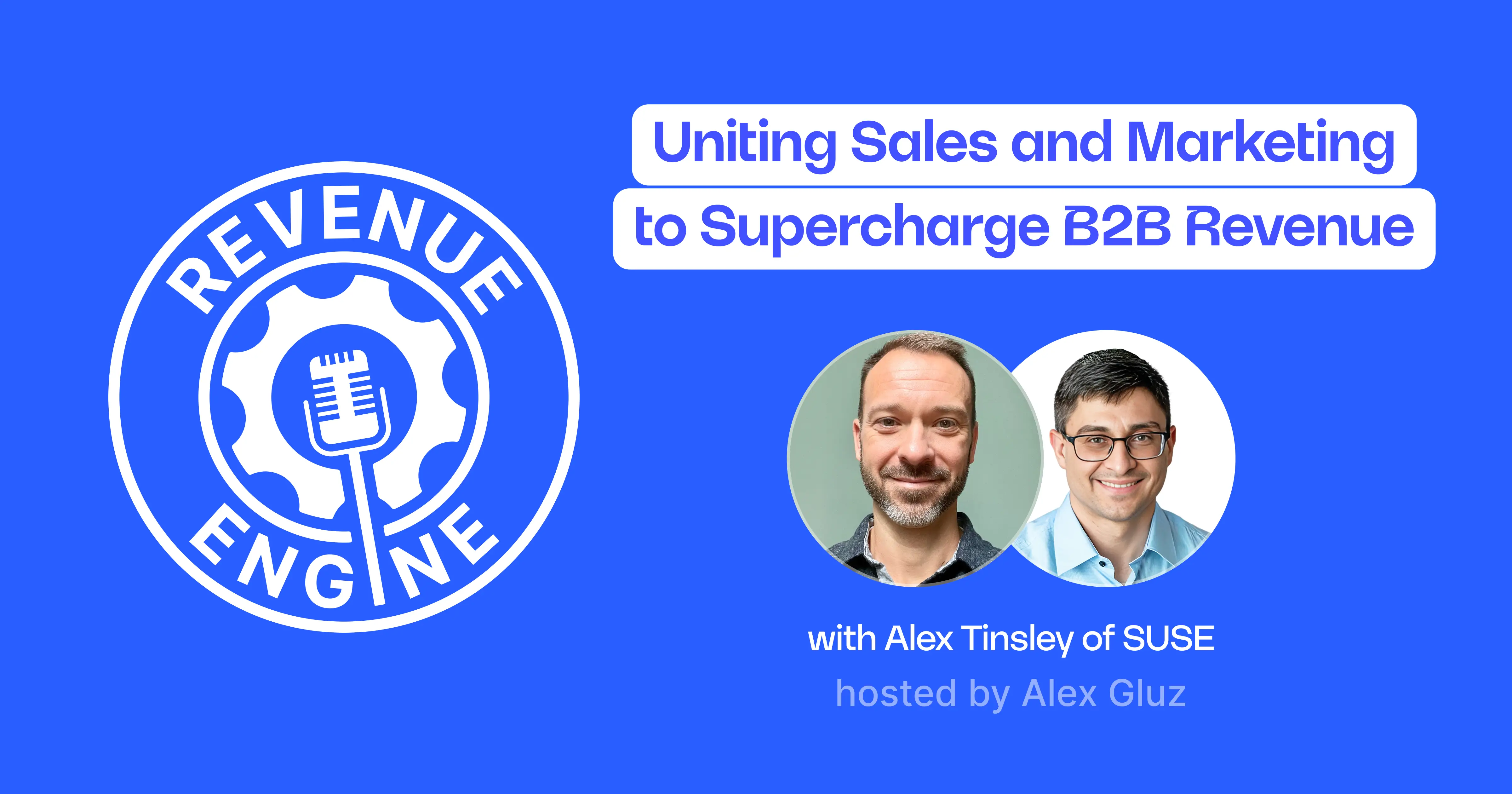
Alex Tinsley: Alex Tinsley. I’m the director of North America Field Marketing at SUSE. We are the revenue-generating marketing arm of SUSE for North America.
Alex Tinsley: What that means is our direct partner is sales. We map directly to sales. We work with sales to get opportunities developed for them, and then we work with them to support, surround every effort to help that opportunity change to bookings, to revenue.
Alex Gluz: That’s great. I’m really looking forward to this conversation. I just literally had a conversation within my team and one of our clients how the sales and marketing team is disconnected. Always a hot topic.
Alex Gluz: Looking forward to this, but let’s take a step back. How did you get started? What did you go to school for?
Alex Tinsley: That’s interesting. I went to school to be a lawyer and quickly changed to business after I took one business class. I saw that it was an opportunity for me to shine, as I’m so curious on how the world works.
Alex Tinsley: Business is a great amalgamation of people and economics and every aspect of every human, at least here in the United States of America. We wake up thinking about money and we go to bed thinking about money, as the joke goes.
Alex Gluz: What were some of your first jobs after college?
Alex Tinsley: I worked in restaurants. I worked as a bartender. I was in construction, and I moved up within those organizations into management and learning about the business.
Alex Tinsley: Then someone said, “You should go into sales. By the way, software sales is where you make the most money.”
Alex Tinsley: I started looking for jobs and quickly found a job in the Washington, D.C. area. I fell in love with the sales operation and mindset and all the aspects of it.
Moving from sales into marketing
Alex Gluz: What brought you to marketing, back from the sales side?
Alex Tinsley: Sales was exciting. It had its ups and downs of making money, not making money, and going through each of the cycles, the quarters, the renewals, and meeting people and trying to get new business. Those are all exciting.
Alex Tinsley: Then, in the times that it was a little slow, I would go talk with marketing. Be like, “Hey, you’re not delivering.”
Alex Tinsley: Then I’d come back and my peers would say, “They never deliver. They don’t do anything. I don’t know what they do over there. All they do is events and they give out tchotchkes or gifts or whatever.”
Alex Tinsley: Sales teams complained about marketing; marketing complained about sales teams. I’m of the personality that I don’t like anything to repeat a few times. I don’t even watch reruns of TV shows. I don’t watch movies more than once, usually. It bores me.
Alex Tinsley: I went over to the marketing side and I sat down with them and I said, “Look, this is silly. You guys are complaining about us, we’re complaining about you. It’s that whole us versus you versus us. Can you all walk me through what it is you do? I just want to see what you do on a daily basis.”
Alex Tinsley: “I want to know if I can help. I want to help change the perception. I want to help you better. I want to learn something to help me better. I want to also change the perception of sales for you.”
Alex Tinsley: I just sat there and learned and tried to understand everything. I shared with them what the salespeople go through. Then we worked together for a little while, a little more closely, on how we could pass leads better with the information, feedback loop, those kinds of things.
Alex Tinsley: Eventually they asked me to be on a special committee for internal marketing purposes. I said, “Okay, I’ll do it. Let’s make this happen.”
Alex Tinsley: After a while, sales, yes, it was very nice, but marketing started to intrigue me much more. I ended up making the switch. I wanted to be more of the change that I saw happening. I took that on as a sense of pride for me.
Alex Tinsley: My mission is to make marketing and sales work together more effectively to both outcomes. Sales individuals want more money booked, more deals booked so they can have more money. Ultimately, the company needs more money.
Alex Tinsley: Usually marketing gets paid a bonus of some sort because of the company’s performance. All in all, we’re all working for the same goal. We just didn’t know it or we didn’t talk about it.
Aligning sales and marketing around revenue
Alex Gluz: So true. Being involved on both sides and now being on the operational side too, what do you think is one thing both teams still get wrong about each other?
Alex Tinsley: It’s just the perceptions. It’s the same thing that I was going through.
Alex Tinsley: When one doesn’t take time to understand what motivates the other and what gets in the other person’s way, whether it’s in a job or in life in general, they create their own story about the other person.
Alex Tinsley: In sales, if they aren’t working closely with the marketing person that is assigned to them or within their region, then you make up a story about what they do because you don’t see them. They must not do much. And the marketing person as well. It still happens all the time.
Alex Tinsley: It’s a boring process because everybody knows you’ve got to seek to understand and be curious, and you’re partners in this. You can’t do one without the other. Why not just ask, “What do you do? How do you do what you do?”
Alex Tinsley: I think that’s what they get wrong. It’s the age-old story of just ask.
Alex Gluz: This is such a common theme in the industry at the moment.
Alex Gluz: From what I heard from marketing leaders over the years, marketing and sales often just don’t understand each other’s realities. Sales teams are chasing immediate revenue, while marketing teams are trying to create long-term strategies where the payoff is not clear.
Alex Gluz: It seems the main issue is that both teams need to be aligned, but often they are on different pages about what the goal even is. I think it’s about focusing on the common ground.
Alex Gluz: Like you mentioned, sales should give marketing insights into what type of leads actually close, and marketing should ensure they are delivering the leads and prospects that fit the sales team strategy.
Alex Gluz: Getting both teams on the same page isn’t easy. But when it happens, they can transform how they work together and drive results for the organization.
Alex Tinsley: Absolutely. But that does start with conversations at the individual level, trying to understand what each other does. The only goal is the end goal, which is revenue. That’s the only goal.
Alex Gluz: Right. That’s the high-level conversation, and it’s always important to have the bigger goal in mind. It’s offense and defense and special teams, but it’s all about winning.
Alex Tinsley: It is all about winning.
Alex Gluz: It’s all about winning. It’s only W. When you look at the records, you look at the W. Sorry, we go into football seasons.
Alex Tinsley: That’s great. That’s absolutely right.
Alex Tinsley: The interesting thing is, though, sales and marketing and the peripheral around those two specific roles tend to forget that they each have the same goal. They have a perception of how to get to that goal, and they may be different, but when they can align, that’s where the magic happens.
Alex Tinsley: Like you’re talking about, that’s where the magic happens. You remind each other what the goal is, and then each of you has your own job. Let them do their jobs.
Alex Tinsley: If you want to go back to football, the quarterback has their job. The quarterback either throws the ball, hands the ball off or runs the ball. There are three major scenarios that the quarterback does.
Alex Tinsley: If there is no one to receive the ball or take the ball or stop other people from stopping the quarterback from running, then the quarterback doesn’t matter. If the ball is not coming to the wide receiver, it doesn’t matter. If the ball isn’t handed off to the running back, then the running back doesn’t matter.
Alex Tinsley: They have small parts and they do their thing, but nobody remembers what they did because the ball didn’t go to them.
Alex Gluz: Right.
Alex Tinsley: That’s the same thing in marketing and sales. If there’s no good handoff, if there’s no good transition of ownership of the next step or what their steps are, or what their path or process is, then success cannot be had.
Where revenue operations should report
Alex Gluz: You also do revenue operations. This question comes often: should RevOps report to marketing, sales or the CEO, the executive suite? Why do most companies get this wrong?
Alex Tinsley: I’ll start with the last question first. I think most companies get it wrong because of ego. I think most companies get it wrong because of the way they’ve structured themselves, because of the leader’s ego, because of, “This is how we’ve done it. I need to own this because of these reasons. This needs to be here because the budget’s here. This needs to be here because of whatever reporting structure had been decided.”
Alex Tinsley: But the fact is, if you put revenue operations under the CEO, then the CEO only cares about revenue, or the CEO doesn’t care about revenue and doesn’t give revenue operations the proper attention and the proper partnership.
Alex Tinsley: The CEO must care about many more things than just revenue. Revenue is an outcome from all the things the CEO must do.
Alex Tinsley: But revenue operations should only care about how we get revenue the fastest, most efficient and effective. How much does it cost us to get $1 of revenue? How can we get that to the cheapest way possible? How can we get our people the most productive as possible?
Alex Tinsley: We’ve got 50 AEs and we need to make a million dollars. Each of those 50 AEs needs to bring in $20,000. If they bring in 17, you fail. If you bring in 22, great. That’s all they should care about.
Alex Tinsley: When revenue operations reports to the CEO, it makes it a big challenge to the CEO to give the revenue operations team the proper attention. And the opposite: if revenue operations is getting the proper attention that they deserve and need, then the CEO is spending too much time with revenue operations.
Alex Tinsley: Revenue operations should not sit with marketing either. A lot of what marketing does is to ensure that there’s a tangible future, and consistently delivering a tangible future and creating opportunities in the future.
Alex Tinsley: Revenue operations doesn’t work in the future. They help people prepare for the future with intelligent data to make decisions on hiring, any exiting that needs to happen, growth within teams. How are they going to expend if they need to spend or invest in certain areas? Can we afford it? And many other things.
Alex Tinsley: Revenue operations is most in the now and the near now, not the long-term future. They help inform the long-term future strategy.
Alex Tinsley: Revenue operations, at least in my experience, in my mind, the best organizations, the most productive, the highest growth and most successful organizations that I’ve seen, read about and have been a part of, report into the CRO, the chief revenue officer, the sales leader.
Alex Tinsley: I fully believe that is where they should stay and that’s where they should be. But also, the CRO should have field marketing. That’s where I sit. I report into the CRO. Revenue operations reports into the CRO, and all the GMs around report into the CRO.
Account clustering and customer segmentation
Alex Gluz: That makes a lot of sense. When we talked a little bit before the interview, you mentioned working on account clustering and segmentation. What’s your view on account segmentation that goes against traditional B2B methods?
Alex Tinsley: It really depends on the size of your organization, the type of product or services that you sell and where your market is.
Alex Tinsley: The companies that I’ve worked for in the last 15 years in sales or marketing have been software, enterprise software to be specific, and most of the last 10 years has been with open-source software. It’s a very niche of a very small industry, of a very powerful industry, but small comparative to the rest of the industries that people work in.
Alex Tinsley: When we take a look at clustering and segmentation, we’ll take a look at North America, for example. A lot of companies focus on the mid-market. There’s a lot of revenue to be had in the mid-market.
Alex Tinsley: If you define the mid-market, it can be anywhere from a hundred million to a billion. It could be anywhere from 250 million to a billion and a half. I’ve seen it a bunch of different ways, defined by different companies, defined by different agencies around the globe.
Alex Tinsley: It could be by employee size of maybe 5,000 to 10,000. Whatever you want to look at, it’s roughly 35,000 to 50,000 companies in the U.S. alone, just the United States.
Alex Tinsley: However, there are also 500 companies, the Fortune 500 companies. Those Fortune 500 companies deliver two-thirds of the United States of America’s GDP. Two-thirds. Five hundred companies or 40,000.
Alex Tinsley: You could look at both of those markets, and I’ll leave all the small and medium businesses out for just a second because I think this number is big enough to think about. You have over 40,000 companies to go after, with less than 1% delivering two-thirds of the GDP of America.
Alex Tinsley: Depending on your business and what your core tenets of channel of delivery or products or services, you want to take a look at all of this. You can either go after all 40,000, 50,000 companies, which is a lot to chew. Where do you get started? You’ve got to start with one.
Alex Tinsley: Or if you have a sales team of 50 and they each have a hundred accounts, it’s 5,000 accounts they’ve got to go after. You’re still only scratching the surface. You’re looking at 12.5%.
Alex Tinsley: The point being is you’ve got to figure out a way to attack all of the business that could be had wherever your market is. If you have particular solutions that are better suited or have core use cases in particular industries, you might want to start there and not try to serve all of it.
Alex Tinsley: It’s really impressive how some companies get started, like some of the new tech wearables for sports. We’ll go on a different sports theme for a second.
Alex Tinsley: When a couple of these companies got set out, they wanted to get very specific with highly successful athletes to make sure that their data and their products are really good for successful athletes, like professional athletes. They started with that market.
Alex Tinsley: They figured if they could get that right, then they could show the value to the high-performing amateurs and then the high-conscientious mid-range amateurs like myself. I want to be better than I am, but I can only be as good as I can. The data helps me achieve that potential.
Alex Tinsley: They started with their core, with a tight cluster to get everything right. The great news is, and I had this conversation yesterday, this is so amazing: what you do with clustering and segmentation, if you get it right for a particular cluster, scale will come organically. You cannot hold scale back.
Alex Tinsley: If you’re so successful with your core customers and you get all the basics and you execute excellently, scale will organically happen because other companies and other people will be coming at you, trying to get what the competitors have and what others want and what others have.
Alex Tinsley: The problem with it is, if you don’t execute excellently and stay to the basics and deliver to a core set of customers, then how can you scale without understanding what you’re doing really good first?
Alex Tinsley: As soon as you start to scale without understanding and getting everything right, or as close to right as possible, your vulnerabilities will get larger and things will start to fall apart quicker. It will be much more difficult to fix.
Alex Tinsley: That’s why clustering, account segmentation around what your core tenets of business are and your core deliverables, no matter what industry you’re in, particularly in software.
Alex Tinsley: If you spend a bunch of money on enterprise software and you fail, that’s someone’s career at that company. What do you think they’re going to do and what do you think they’re going to say? Not good.
Alex Tinsley: But if you get it right with Amex, for example, or you get it right with an even smaller company, maybe there’s a construction company that I know about called H.G. Reynolds. You get it right there, then you can go to another construction company, and then you can go to a construction company supplier like Home Depot or Lowe’s.
Alex Tinsley: You can start scaling out because you have these core wins. That’s clustering and segmentation. A lot of it goes against the traditional.
Alex Tinsley: When I first got here and when I got to other companies, they’re like, “We need bookings, we need revenue, we need customers. We’ve got to go, go, go.”
Alex Tinsley: A lot of teams are set up to just hunt and go and get business and then hopefully renew. Then they don’t renew, so they’ve got to go get more business and more business.
Alex Tinsley: But if you cluster things, you can ensure net-new business and renewals from the customers that you have. They trust you and you can just keep building out from there. Scale won’t be a problem because it’ll happen organically. It’ll be forced upon you.
Alex Gluz: What you said is amazing, and there’s so much to unpack here. Have you ever read Crossing the Chasm or heard about Crossing the Chasm? That’s the book, and it’s from the nineties. That’s exactly what they talked about.
Alex Gluz: Clustering and really going after the segments, and making sure the segment you go after, you’re really successful at that segment before going to the next. That’s where the organic growth comes, versus trying to go super broad.
Alex Gluz: Traditional B2B segmentation often focuses on broad categories like company revenue, size or industry. But it’s not effective in 2025. What I believe in is segmenting by real customer needs, behavioral signals.
Alex Gluz: It’s not enough to say we’re going after companies with a certain number of employees, a certain number of revenue or industry. That doesn’t tell you anything about why they need your solution and they need this now.
Alex Gluz: Instead, we should be segmenting based on pain points, intent signals and readiness to buy. Some smaller companies may need enterprise-level solutions, and some larger companies may be looking for something more nimble.
Alex Gluz: Segmentation needs to be about understanding the buyer’s journey, not just who they are. Focus on real problems they’re trying to solve and segment based on that, making sure you’re targeting the right account with the right message.
Matching resources to intent signals and markets
Alex Tinsley: Absolutely. And you apply the right resources to those.
Alex Tinsley: I would even go a step further and say, even within your addressable market, within the cluster of accounts, within the intent signals that you have, you need to understand how many intent signals are going to be the ones where you put your most expensive resources, which are your people. Then you need to work out from there.
Alex Tinsley: Say you put three criteria on there, and you put your very expensive people resources and maybe a little bit of money resources.
Alex Tinsley: Then, when you go out one ring and they may hit two out of three of your critical measures of how you want to go after the market, you can apply a little bit more marketing resources, a little bit more money resources and a little bit less expensive people.
Alex Tinsley: Then one out of three categories. You can keep it going and make sure all those signals are coming, just at different speeds and with different resources, so that you can make sure that you maximize the resources that you apply to your clustering, the way that you use intent signals and the way that you apply the right message to the right account.
Alex Gluz: Totally. That’s also one of my favorite subjects, really the resourcing and making sure you put the right resources at the right time.
Alex Gluz: One of the great examples, and it’s easy to understand. Let’s say they’ve been in the United States and they want to go outside of it. They’re like, “We’re going to go to South America, the Latin market.”
Alex Gluz: But it’s not enough to just translate things. You need to understand the culture. You need to put the right resources so it all makes sense.
Alex Gluz: Then you go and you’re like, “It’s not working.” But you didn’t put the right resources for this to work. The resourcing, you’re so spot on, Alex.
Alex Gluz: It’s definitely a big part of it, making sure you do provide the right support and give it the right time too.
Alex Gluz: You don’t want to spread too thin. That’s another thing.
Alex Tinsley: That’s right.
Building trust with channel partners
Alex Gluz: You worked at both software resellers and vendors. What’s the biggest mistake vendors make when building revenue engines that rely on channel partners?
Alex Tinsley: We’re going through this right now, and it is dear to my work heart, if I could say that.
Alex Tinsley: The reason why is because the easiest thing to do is to partner and let someone else do work to help you scale. It seems like a no-brainer, but vendors get in their own way.
Alex Tinsley: There are some vendors who get it right. Most famously, Microsoft gets it right. Let’s forget about what they do and how they treat their people and their employees and all that stuff. However, what they do get right is they have a partner-first model. They have an ecosystem that is phenomenally built.
Alex Tinsley: Again, I can’t talk about how they treat it, but the ecosystem: they build products and services that are missing parts, and the way they tier their ecosystem is how those partners in that ecosystem fill in the gaps for the customer.
Alex Tinsley: That is amazing because that’s a true partnership that says, “We trust you enough that we’re going to give you 90. I’m making the number up for a second. We’ll give you 90 of what you need to be successful in the sale, but we need you to finish it for the customer and build the relationship with the customer so that it delivers and satisfies them.”
Alex Tinsley: They look at the vendor going, “Great product, and I’ve got great people to work with in our ecosystem.”
Alex Tinsley: The reason why I start off with that is because that’s a very positive look at it. I know that it is very complicated, and it’s not always roses and everything like that. But the partnership works because in the premise is automatic trust.
Alex Tinsley: The issue with a lot of companies, and the company that we’re trying to work through and a couple of previous companies, they started as direct selling to customers. B2C, they started direct selling and then they added in partners.
Alex Tinsley: The issue with that is, sales, and it’s a good thing, they’re very, “What about me?” It is viewed as, “They’re cutting into my margin. They’re cutting into my paycheck. They’re cutting into the deals. They’re going to cost me money if I work with them.”
Alex Tinsley: The more successful salespeople, at least in the software industry that I’m in and with the ecosystem, are the ones that leverage the partner ecosystem to scale their business and grow their business.
Alex Tinsley: It’s not always on the shoulders of the salesperson, and you can use the machine to help you print money. They’ve got more people. They’ve got more reach. They’ve got more contacts.
Alex Tinsley: Giving up a little margin here and there and getting more and larger deals actually is getting more money in your pocket.
Alex Tinsley: The reason why I’m bringing up all this, and I know it’s an oversimplification of it, but the perception of the partner ecosystem is what a lot of companies get wrong.
Alex Tinsley: They force it. They say, “We’re going to do this now. We’re going to work with these partners.”
Alex Tinsley: “But that’s not the partner that my customer cares about, so I’m not going to work with them. I’m going to work with this other partner. They’re just going to close the deal for me, and I’m going to give them one or two points instead of the 10 or 15 they should get.”
Alex Tinsley: There’s this very transactional view because of “stealing from me.” It’s the perception.
Alex Tinsley: Whenever a vendor says they want to do channel or they want to improve the channel, what they get wrong is the internal systems and processes and perception of the ecosystem. That needs to be the beginning. It needs to start there.
Alex Tinsley: We need to prioritize the perception, the processes and make everything about the partner so that they do what we all say they’re going to do. They’re going to scale our business. But we say that and then don’t back it up with the trust.
Alex Gluz: It’s a very interesting take on this, and it’s so true.
Alex Gluz: Also, I think you’ve been on the RevOps side. You see these things and you understand how this works more at certain levels of growth.
Alex Gluz: Yes, you have to give bigger percentages and the margin thing, but you’re also reaching some limits in your sales, and this gives you this bigger force out there, even though you’re sharing.
Alex Gluz: If you look at the big picture, it’s really valuable and it’s really letting you scale. That’s a great take on this and a really interesting question to discuss.
Marketing challenges, technology and education
Alex Gluz: What do you think are the biggest pain points for B2B SaaS and tech marketing leaders in 2025?
Alex Tinsley: Too much choice, too many things to try and do. One of the biggest things is internal tech stack and internal processes.
Alex Tinsley: I’ll go back to the basics. I’ll go back to the maniacal focus on excellent execution. If your marketers don’t understand how the tech stack works, then how are they going to use that tech stack to optimize the output for their input?
Alex Tinsley: Think about it simply: it’s a machine. Just like people say about calculators, they’re a machine. If you input the wrong numbers in the calculator, it’s going to give you the wrong numbers in the output.
Alex Tinsley: If you don’t understand how math works, even simply, then how would you know the output was wrong or is not as good as it could be?
Alex Tinsley: You don’t have to be a math wizard. But if you don’t understand simple algorithms of percentages, then you can’t even get close to the answer or knowing that the answer might be wrong.
Alex Tinsley: It’s the same way with your tech stack, the same way with your marketing process or your sales processes. If you don’t understand what it takes on an input to get the output you desire through the system, then when the output comes out, you don’t know if that’s as good as you can get or not.
Alex Tinsley: You just know either we missed or we didn’t miss. Then you’ve got to backtrack every little bit, trying to do forensics on it. Or you just start shoving more into the top and spending more money and wasting time, and then more output comes out.
Alex Tinsley: But you don’t know if it’s the best output or not until a salesperson, a very expensive resource, starts working it. Then you lose trust because they think it’s garbage.
Alex Gluz: The biggest pain points, and I talk to so many people, two themes always emerge. It’s AI disruptions in many different forms and also economic pressures.
Alex Gluz: Everything in general, the prices are going up. The cost to acquire a customer is higher. Buying traffic is higher. Going to events is higher. Nothing is cheaper. Let’s be real about this.
Alex Gluz: On top of that, what you mentioned is the shiny tool syndrome and all of this. The technology and things like that, we can’t stop this. It’s unstoppable. It’s not something you can control or stop in that way. But the biggest gap is in education.
Alex Gluz: Like you said, if you don’t understand the fundamentals, the basics. Yesterday I was reading somewhere in social media, which I try not to, except LinkedIn. It’s more or less okay if you follow certain people.
Alex Gluz: But it was like, “The ChatGPT, I have to correct it all the time.” You just don’t know how it works. You really don’t understand how it works.
Alex Gluz: What I’m saying, Alex, is even if you go to the biggest organization and you ask the smartest people there, “How does this thing work?” They’re like, “I know a little bit. I use it. A few things I know, but I don’t know a lot of it.”
Alex Gluz: It’s going to continue like that. Without proper education and being aligned also, because my understanding and your understanding could be completely different on certain things.
Alex Gluz: If we’re on the same page and have the same understanding of how things work, how it all aligns and the bigger goals, it’s there.
Alex Gluz: But the AI disruption is very real. It goes on different levels. It goes internally, like you said. Also, it goes externally because there’s so much noise. It’s a problem of how do you stand out, how do you differentiate yourself?
Alex Gluz: Again, we’re going back to the basics and really focusing on segmentation, clustering, understanding endpoints, the buyer journeys and really crafting the solutions, which are not temporary but long term.
Alex Gluz: Also, building the partnership system, like you said, and the channel system. That’s my little take on that.
Understanding AI tools before using them
Alex Tinsley: Absolutely. I just want to emphasize that there’s always been tools since the invention of the first tool, but you have to understand how the tool works in order for you to get the best outcomes from the tool.
Alex Tinsley: The tool can be a process. The tool can be AI. It can be other shiny objects.
Alex Tinsley: But if you don’t understand, one, what your goal is; two, how would you get your goal if you didn’t have these processes, if you didn’t have these tech stacks? Then start to get better by adding things in that help you get better and better.
Alex Tinsley: It goes back to the whole clustering and the segmentation. I think everything can be defined by this because once you get the basics and the desired outcomes absolutely rightly, executing excellently, then you can add more, and that’s how you scale again. It goes back to organic scale.
Alex Tinsley: But if you overcomplicate by using AI to use AI because everybody’s using AI, without understanding which AI platform or which AI tool or what the prompts are for each of these AIs, and how the algorithms are built or why they were built, what the outcomes of them are supposed to be for, then you’re going to get frustrated.
Alex Tinsley: You can’t go to an ATM and get a loan. Yes, it’s part of a bank. Yes, it’s something that knows what your numbers are. Yes, you know how much money you have. It might even have a little bit of other information.
Alex Tinsley: Some ATMs are now saying you can have investments in this and that or whatever, but you can’t ask it questions it doesn’t have information for.
Alex Tinsley: Understanding what the AI tools are or what any of the processes are, understanding what the outputs are, what the algorithms are designed for, what’s going into the algorithms, where it’s pulling information from, how you prompt.
Alex Tinsley: Asking better questions always gets better answers, and sometimes the better answer is, “I don’t know.” Great. Ask a different question. Ask a simpler question.
Alex Tinsley: Always verify, and make sure you’re getting what you actually are looking for.
Mentors, decision-making and closing remarks
Alex Gluz: What great advice. I have one last question for you, Alex. Who are your mentors and the best advice they gave you?
Alex Tinsley: I’ve had a lot of mentors. I look at people to share their perspective, whether or not I agree with it.
Alex Tinsley: I learn a lot from just ingesting people’s, whether they’re giving me information or they’re giving me other types of information called feedback, positive, negative or indifferent. I look at many different people as ways to grow.
Alex Tinsley: I’m continuously, and sometimes to my demise, very curious about how everything works and how people operate and just how we could be better humans. I apply that everywhere.
Alex Tinsley: The best mentors I ever had, I currently report to two. I have two bosses, and they both are completely different people but are very good mentors.
Alex Tinsley: One is a nonstop machine and just keeps moving forward, constantly moving forward and always ingesting information and working to get the better outcomes.
Alex Tinsley: The other mentor is more thoroughly thoughtful and intentionally slower in how and when they move.
Alex Tinsley: Both help me in the ways that I need to grow, where I can run really fast and keep going and not care and just keep ingesting and taking things. The other one is the exact opposite, where I don’t move because I don’t know if I want to do anything, so I just sit on it.
Alex Tinsley: Taking both of them and their mentorships and what information and things they guide will help.
Alex Tinsley: But the biggest piece of advice I’ve had was from a mentor I had a couple companies ago. She was probably, at this point in my life, the greatest mentor as far as what did I learn?
Alex Tinsley: The biggest thing I learned from her, and it may have been something somebody or my parents had always told me all my life, but I finally heard it when I got it from her.
Alex Tinsley: There was a decision that wasn’t being made. At this time, I was running a global team. I had people in five different countries around, and in all the continents, and teams of people.
Alex Tinsley: Something wasn’t being decided that was above me. I needed them to decide it, and they weren’t deciding it. I just said in my head, “What would happen if I just decided it and pushed it out anyway?”
Alex Tinsley: So I did. Immediately I was called by several different people and said, “You need to shut this thing down. You need to recall it. You need to do this.”
Alex Tinsley: I said, “Okay.” I did mea culpa, and I went on an apology tour and I recalled it. I did all this stuff, and everybody was so helpful. They were like, “Oh my gosh, sorry you went through this.”
Alex Tinsley: I had to apologize to so many different people.
Alex Tinsley: But my mentor, I called her and I said, “This is what happened. Oh my gosh, I’m sorry. I’ll do what it takes. This is what I did.”
Alex Tinsley: She just flat out said, “Did we lose a customer?”
Alex Tinsley: I said, “No. It had nothing to do with affecting any customers.”
Alex Tinsley: She said, “Don’t worry about it.”
Alex Tinsley: The reason why I say that is the biggest piece of advice or biggest nugget I got from any mentor translates to: you don’t have to always make the right decision because you never know what the right decision is at any given moment. But when you make a decision, no matter what, make that decision right.
Alex Tinsley: I made a decision in the moment because we needed to move forward and nobody was willing to take a chance. I took a chance. Some people thought it was the wrong decision, but I still stand by, I believe it was a decision that needed to be made.
Alex Tinsley: To make the decision right, I had to go on an apology tour, which gave me a voice to the people who weren’t making a decision. Guess what happened? It forced them to make a decision. Then we moved forward, and all it took was me saying, “I’m sorry.”
Alex Tinsley: That’s making the decision right. I made a decision I shouldn’t have, according to a lot of people. What I did is I said, “I’m sorry,” to make the decision right. Then people started working on it.
Alex Tinsley: Don’t be afraid to make decisions. Just make the decisions. You make those decisions right.
Alex Gluz: We’ve been talking to Alex Tinsley. Alex, where can people learn more about you? On LinkedIn?
Alex Tinsley: Alex Tinsley. I work at SUSE. I’ve worked at Red Hat, Riskified, Mattermost and a host of other companies. You can find me, chat with me. I’ll connect.
Alex Gluz: For our listeners, if you’d like to learn about how we can help you build marketing revenue engines that empower growth, visit tamonroe.com or contact me on LinkedIn as well.
Alex Gluz: All right, Alex, thanks so much.
Alex Tinsley: Thanks.