Services

Our Services

Paid Media

Drive qualified demand with paid campaigns

Paid Search

Capture high-intent buyers through search

Paid Social

Turn social ads into pipeline growth

Reddit Advertising

Reddit Advertising for B2B SaaS

SaaS Marketing

Scale B2B SaaS growth with full-funnel strategy

Creative & Content

Craft visuals and content that convert

Web Design & CRO

Design optimize to drive revenue

All Services Overview
Success StoriesPricing
About
About Us

Who we are and how we work

Our Team

The people behind the work

Careers

Join the T.A. Monroe team

FAQ

Common questions answered

Contact Us

No pressure, commitment free

Resources
Resource Hub

All resources in one place

Podcast

The Revenue Engine Podcast

Free Resources

Free growth hacks

Contact Us
Book a Call
Book a Call
All resources
Podcast
12
min read

How do you attribute B2B pipeline to marketing? With Brandon Rhoten

November 21, 2025

Table of Contents

>
Heading
>
Heading
>
Heading
>
Heading
>
Heading

Former GroundTruth CMO Brandon Rhoten spent his career proving that advertising put people through physical doors. Recorded November 2025, before the newest blind spot opened: a growing share of buyer research now happens somewhere your analytics cannot follow.

Updated September 2026. This episode was recorded in November 2025. Brandon’s argument that marketing should be defended in business terms has not aged at all. What has changed in ten months is how much of the buying journey is visible to any analytics tool, which is why we have added a section on the blind spot that opened after this was recorded.

By tying campaigns to pipeline and revenue rather than to channel metrics, and by testing the model rather than trusting it. Run controlled experiments, hold back spend in one region or segment, and see what actually moves. Accept that a growing share of the journey is now invisible to analytics, and report what you can prove alongside what you can only infer.

What You Will Take Away

1. Get the language right before you get the model right.

Brandon’s framing: “marketing’s seen as an investment and not an expense.” That sentence is a budget outcome, not a philosophy. A CFO funds investments and cuts expenses, and which one you sound like is decided by the words you report in.

2. Most blind spots are self-inflicted, and one no longer is.

His line was “if you have blind spots in your funnel now, it’s your own fault,” said in November 2025, and for tracking and instrumentation he is right. What changed since then is not your fault. G2 found in March 2026 that 51% of B2B software buyers now start their research in an AI chatbot, up from 29% eleven months earlier, and those sessions pass no referrer. That research arrives as direct traffic or as nothing.

3. The linear funnel was always a convenient fiction.

Brandon, on how buyers actually behave: “People jump all over the place.” Attribution models that assume an orderly path produce tidy numbers about a journey nobody took.

4. Test the model, do not trust it.

The most useful technique in the episode is the least fashionable: controlled experiments. Hold spend back somewhere, keep it steady elsewhere, and measure the difference. It answers the question a multi-touch model only appears to answer.

5. Cutting marketing under pressure has a bill that arrives later.

It is the cheapest line in any budget to cut because the damage is deferred past the quarter in which it is cut. In a business where a deal takes six months to close and another six to bill, cutting today hurts next year. The attribution case is what makes that argument survivable in the room.

6. Some of this is craft, and pretending otherwise fails too.

“Art is great, but we are art in the service of commerce.” A measurement culture that cannot account for creative quality ends up optimizing toward whatever is easiest to count.

Listen to the Full Conversation

Spotify Apple Podcasts Amazon Music TuneIn Pandora Deezer

Want our paid media team to take a look at your campaigns? Book your strategy call here.

About the Guest

Brandon Rhoten, former Chief Marketing Officer at GroundTruth. GroundTruth uses location and purchase data to connect advertising to store visits and revenue, which is the hardest version of the attribution problem: proving that something someone saw led to something they later did somewhere else. Before GroundTruth he was Chief Marketing Officer at Papa John’s and Potbelly, and before that he built Wendy’s digital and social marketing program and ran its consumer-facing marketing for around six years. He credits the CEO who hired him there, Emil Brolick, and the wider team with the 40 quarters of growth that followed.

About the Host

Alex Gluz, CEO, T.A. Monroe. Alex hosts the Revenue Engine Podcast and builds performance-driven growth frameworks for B2B SaaS companies, with a focus on customer acquisition, demand generation, pipeline, and measurable revenue outcomes.

In This Episode…

A marketing leader is asked to prove what marketing contributed, and cannot. The dashboard reports channel performance. The CFO does not care about channel performance. That gap is where most budget arguments are lost.

Brandon Rhoten has spent his career on the hardest version of that problem. At GroundTruth he connected advertising to whether someone physically walked into a shop. Before that he ran consumer marketing at Wendy’s and was CMO at Papa John’s and Potbelly. His argument is that the measurement problem is mostly a language problem: marketers report in reach and impressions to people who run a P&L, and then wonder why the budget is the first thing cut. If you can prove a television advert drove a store visit, proving a LinkedIn advert drove a demo request is the easier version of the same discipline.

In this episode of the Revenue Engine Podcast, Alex Gluz talks with Brandon Rhoten about B2B marketing attribution: why the linear funnel was always a fiction, why controlled experiments beat multi-touch models, how to report marketing in terms a CFO will accept, what cutting marketing under pressure actually costs, and where AI genuinely helps. We have added what changed after the recording, which is that a growing share of buyer research now happens where no analytics tool can see it.

What Is Covered

TimestampTopic
02:43Introduction and Brandon Rhoten’s marketing career
05:59Attribution and the changing buyer journey
09:47Connecting digital and physical customer experiences
16:21Explaining marketing results to finance and leadership
19:16The consequences of cutting marketing budgets
24:22Balancing creative work and measurable business outcomes
27:56Moving from television reach to outcome-driven media
35:19How GroundTruth measures outcomes and why transparency matters
39:47Using AI to optimize media and creative
43:44Mentors, marketing inspiration and closing remarks
Episode transcript

Introduction and Brandon Rhoten’s marketing career

Alex Gluz: We have a great guest for you today. Super excited. Brandon, nice to have you here.

Brandon Rhoten: Thanks for having me.

Alex Gluz: Can you do a brief intro of who you are and what you do?

Brandon Rhoten: I’m the CMO of a company called GroundTruth, which is an advertising platform that connects foot traffic to media. It allows B2C companies, typically, to understand the effect of their media.

What we say is, use real-world behavior, things like where people are in the world and what they buy, to drive real business results. Get to people showing up to your retail or restaurant location.

Alex Gluz: Very cool. How did you get started? What did you go to school for?

Brandon Rhoten: I went to school originally for biology and learned pretty quickly that I hated chemistry. That ended up making me switch over to marketing.

Really, the reason I switched to marketing is it’s not fundamentally that different than biology, I’d argue. It’s cause and effect. It’s understanding the way the world operates and how people make decisions.

I ended up in marketing. That led me to a digital marketing agency. That agency got a lot of attention, which attracted Wendy’s to grab me up. Wendy’s, the fast-food company, asked me to build their digital social marketing program.

Did that. Ended up running consumer-facing marketing for them for about six years and saw significant growth in that organization while we were there.

That led me to be the Chief Marketing Officer of Papa John’s and Potbelly. Then I semi-retired for a bit. Those companies had done really well. The teams did awesome work that led to stock growth and all that good stuff.

Lasted about three months of retirement. My wife’s like, “Hey, you ain’t done yet. You’re driving me crazy. You need to go find something to do.”

I joined a bunch of boards. That led to the relationship with GroundTruth. Really, what attracted me to the advisor role and ultimately the CMO role at GroundTruth is understanding the effect of marketing on the business.

As a CMO at a large company, spending hundreds of millions of dollars on media a year, you’re accountable for driving results.

In the seven, eight billion dollars in media that I put into the world, I can probably account for 20, 30% of it, if I’m lucky, exactly what it did. We saw growth, but that direct attribution to impact.

That’s what GroundTruth does. I love that I’m helping marketers every day figure out how their media actually results in an effect on the business, so marketing’s seen as an investment and not an expense.

Attribution and the changing buyer journey

Alex Gluz: It’s a great topic, and I talk about this many times a day, many times a week. It’s an ongoing conversation, and that’s why I was so excited to chat with you.

Let’s dive in. You’ve been in marketing through its entire digital transformation, so to say. When you started at Wendy’s building the digital presence, did you imagine we would still be struggling with attribution in 2025?

Brandon Rhoten: It is a little surprising. Having said that, I joined Wendy’s in 2011, so it’s been a while.

In 2011, social was pretty well established at that point. Mobile was certainly well established. Programmatic was established. A lot of the tools we use were in place in 2011.

Yet the organization, and almost every organization that looked like it, these massive companies with billions of dollars in revenue, really used traditional media as the primary driver without any attribution and just made assumptions on what was working.

Even in 2011, when we’re probably eight or 10 years past when most of this stuff began to emerge in some capacity, it was a challenge to convince the organization to move to more attributable, more discrete and addressable mediums.

The fact that it took 10-ish years to get companies that were well established and had great resources to understand the effect of their media, but just didn’t, doesn’t shock me that we’re sitting here in 2025 and we still have a bit of a mentality of, “This is still a black box. This is still art and not art and science.”

It doesn’t surprise me that it’s still like that because the industry is set in its ways. But the accountability, especially from the boards and CEO and CFO level, has shifted dramatically.

What’s really accelerated the move towards attribution and understanding the effect of your mediums is more the demand of the organization to say, “We need to have these dollars accountable. It’s not just an assumed effect on our business anymore.”

I actually credit the rest of the organization, not marketing, as the driver. Especially media companies and things like that made their money off massive upfront deals and things of that nature.

It doesn’t shock me, unfortunately. But it’s awesome that now we’re capable of measuring pretty much the entire funnel.

If you have blind spots in your funnel now, it’s your own fault. It’s not because the mediums won’t allow you to at least understand the rough effect on your business.

Alex Gluz: The problem is not exactly about the inability to track things. It’s also about drowning in data and being able to decipher it.

The issue is that companies are tracking activities instead of journeys, like you mentioned, the funnels. When somebody lands on your website, bounces off, comes back two weeks later through a different channel, then downloads something or gets engaged with a video, then goes quiet for a month before suddenly requesting a demo or going to the store, that’s a real buyer journey.

But most attribution systems would just credit the last click or last interaction. Understanding the full sequence matters more than the perfect tracking.

Brandon Rhoten: I agree with you. The traditional funnel that is very linear is gone. People jump all over the place. They make decisions in different ways and in ways that sometimes are a bit invisible to you.

Understanding the touchpoints that lead to the most likely outcomes is critical, and the effect of each of those touchpoints on the outcome, so you can make your bets in the places that truly create impact. I think you’re totally right.

Connecting digital and physical customer experiences

Alex Gluz: Something came to mind. The idea of really blending the digital and physical places is just very actual right now.

Last weekend I took the kids to the auto show, which was pretty cool. A lot of activities were, “Here’s the ticket,” or something, a raffle ticket, but punch it into the iPad. A lot of activities are basically trying to gather your data and blend everything together.

You have so much experience in the food industry. Now it’s the apps, and the apps are trying to capture information. You can order through the app. You get perks through the app.

How do you think it’s going, and if it’s going in the right direction? Maybe you still see big gaps.

Brandon Rhoten: I think there are still gaps, and primarily they lie in assumptions about what physical interactions are necessary and what actually adds value.

I’ll use a very specific example from the restaurant industry because that’s obviously where I spent the majority of my time.

A lot of places put up kiosks where you walk into the store and you order through a kiosk. Sometimes that’s good. Sometimes it’s ridiculously annoying and disruptive.

It doesn’t actually improve the experience by any stretch, especially if you’re going into a place where you’re going to spend a decent amount for the food. All of a sudden, you feel like you’re doing a lot of work to get through a transaction that is supposed to be easy and fast and pleasurable.

We oftentimes put technology in spaces that aren’t necessarily ideal for the net experience you’re trying to get.

Even those tablets, the kiosks in stores, oftentimes they aren’t even trackable. It’s not even adding the layers of value for the business that people are assuming.

It might reduce labor in some capacity, but even that, you’re decreasing the experience sometimes by such a stretch that it’s not worth it. There’s a balance to be struck. We have to find the ways that make it feel like magic, make it feel easy.

There are technologies that allow for that. Aware that your mobile device is in the building, that’s meaningful.

A lot of fast-food places now, for example, you place an online order, and when the device gets near the restaurant, that’s when the order drops to the back of the kitchen so they can actually make it.

I was working on that with Apple in 2012. That is such old technology, but it’s just not implemented everywhere and should be.

We should make it easy where you can use things like Apple Wallet. You can use things like tap to pay. It shouldn’t feel clunky. You shouldn’t feel like you’re going to drop your phone out of your window in a drive-through because you have to reach over and somebody’s handing this terminal to you, and it’s all weird.

Obviously, it applies way outside the restaurant world too. Even in the B2B world, sometimes the forms we create and the hoops we make people jump through. You need that data, but there are ways to gather that data over time.

When someone reaches out, you can connect back. You can do some homework, use AI tools in the back end to figure out the details that you don’t have them fill in.

We have to try harder, especially as marketers, to make the experience feel good and not cumbersome because we’re trying to create these layers of later remarketing and later measurement.

It is still really clunky in a lot of cases. There are brands that have figured it out, but the majority of brands haven’t.

Then what happens is somebody does something, it looks interesting, so everyone copies it. Oftentimes it has all that baggage attached to it where it’s not that good, but everyone’s just copying that experience.

Sometimes you can fake it, and it still feels good. Like the Domino’s Pizza Tracker. That’s not real. That uses a timer, basically, to figure it out.

I don’t know for a fact, but I think that’s how it works. The guy, it says, “Jim’s making your pizza.” Odds are it isn’t Jim. Odds are Jim just works there, and the face came up because it’s on the cycle and he’s on the shift at that time. But he probably didn’t touch your pizza.

That’s okay. Make it easy. Make it interesting. Make it useful rather than create these barriers for the experience that you’re trying to create. Across the board, we have to do better at that.

Alex Gluz: That’s great. It’s part of user experience, and we obviously, as marketers and being digital, like to talk about it. But this is a new frontier.

Now I register my phone number. What happens next? Do I get a text? Sometimes you submit your phone number, and then a month later the random text comes in. That is just so random. I’m not going to respond to that. It’s just a random thing because it’s broken.

People understand, I guess, that it’s important and they need to embrace it. But like you said, they don’t look at the value it provides.

Every touchpoint needs to provide value versus just, “We’ve got to do this because everybody else is doing that.”

Brandon Rhoten: Giving the contact information is a great example. If you’re a B2B company or a B2C company, it doesn’t matter. If I give you my information for a purpose, I’m asking you to reach out to me and talk to me about what you sell because I’m interested in what you sell.

It takes you two weeks to respond, or you start spamming me. The default approach in a lot of marketing departments is send more emails, send more texts. It’s quantity.

It’s true, in the aggregate numbers, you end up with more responses if you do that, but you’re ticking off the people that really want to work with you.

Understanding the appropriate level of communication that someone is asking for and the thing they’re trying to accomplish is critical. That’s really hard.

It’s on marketers to really understand: somebody filled out my form. They want to hear from me today. They don’t want to hear from me in two weeks. They don’t want me to spam them continuously unless they ask for the newsletter or something.

Don’t just assume that you can all of a sudden mass-market to anyone who raised their hand. It just makes people hesitant to raise their hand, and that’s not what you want in the end. That actually hurts you. It doesn’t help you.

Explaining marketing results to finance and leadership

Alex Gluz: You mentioned that almost every medium is digitized now. If everything is digital and trackable, why do you think CMOs and marketing leaders are still having awkward and difficult conversations with finance about ROI?

Brandon Rhoten: I think there are two primary reasons. One is a legacy issue. People love running Super Bowl ads. They love old-school big techniques. Those feel cool.

If you take over Times Square, that feels awesome, and it’s impressive. There’s value in that, potentially, for your constituents, for your investors, for maybe your organization and your business.

There’s this art side of it and this emotion side of it that just feels good. That’s one barrier. You have to find a balance there of what feels good and what creates internal rah-rah around marketing because we’re doing something cool.

The other main reason, and this is probably 70% of the problem or more, is marketers don’t speak in the language of everyone else in their organization.

We try to talk about things like reach and impressions and conversion rates. You name the CTR, you name the internal media metric or marketing metric that we use. That means nothing to someone who’s running a P&L.

At the end of the day, people who run the P&L, the CFO, the CEO, board members, speaking as a board member, I care about the business. I care about revenue. I care about foot traffic. I care about check growth. I care about all the fundamental things in my business that lift. Those are the KPIs I care about.

I don’t care about click-through rate. I don’t care about video completion rate. None of that stuff matters.

We should use those in marketing to understand the effect of what we’re doing as a leading indicator. Something that gives us a sense of, is the creative working? Is the medium appropriate? Is even the reach appropriate to get to the outcomes we want?

That’s internal speak for marketers. The second you get past somebody with a marketing title, you need to strike all that from your vocabulary.

You need to speak to your CFO, your CEO, your board, everyone, in terms of: this is the impact to the P&L. This is the impact on the metrics that we care about.

There are metrics that are non-P&L-related that sometimes companies care a lot about: customer service metrics, NPS scores, all that stuff. That’s fine. But it’s got to be in their language.

Marketers are supposed to be good communicators, and we fail dramatically when we show a slide that says, “This is how many likes a post got.” Who cares?

Again, leading indicator for us that there’s interest. Great. Awesome. Celebrate in your marketing department. Don’t celebrate that as the primary reason that your marketing is affecting your business past marketing.

You’ve got to use the language everyone else uses, and you have to show the connection between that work you’re doing in marketing and the effect on the business. That’s the critical missing step for most.

The consequences of cutting marketing budgets

Alex Gluz: That’s one of the layers, and I think that’s part of it. But also there is a fundamental disconnect because CFOs and some CEOs too.

I think CEOs in B2B and SaaS understand digital better than regular CEOs because that’s just the nature of the business, and they know how it works. But they think of marketing like a vending machine.

You insert the budgets. You receive the leads, which lead to pipeline. The pipeline will close, and the more you put, the more you get.

B2B marketing is more like farming. You prepare the soil, plant the seeds, nurture growth and harvest when ready. Obviously aligned with sales and customer success and product as well. Some crops fail. Some exceed expectations.

The successful relationships I’ve seen accept this reality and set up realistic expectations. Like you mentioned, they speak the same language, and the expectations are clear. They have the plan together and understand the timelines together.

When companies are under financial pressure, maybe funding is tougher or economics, marketing usually goes first. They start to chop down the marketing. How do you feel about this, Brandon?

Brandon Rhoten: As a CMO for a long time, I do believe that has serious long-term consequences and short-term consequences often, but very much long-term consequences, especially in a long-sales-cycle B2B business.

If it takes six months to close a deal and another six months to get the revenue actually flowing from that deal, shutting down marketing today hurts next year. It doesn’t hurt this year necessarily.

When you close down the budget, which is understandable when things are tight, that’s the one budget that you have the most control over. It feels, anyway, to someone who doesn’t understand the impact, like there’s a short-term benefit and less long-term risk.

That goes back to the farming analogy you just gave. Having everyone understand what the cycle looks like. How long does it take to get to revenue from an effort? The difference between a leading indicator and something that actually appears in the P&L.

Making sure the organization understands that, and then constantly illustrating that thing happens in real time. You can look back a year, and you can see what happened in your marketing that led to outcomes that are occurring right now.

I think that’s a short-term view. I would also argue that is, again, a bit of marketing’s fault. We don’t show the path to revenue oftentimes, and we don’t speak the same language oftentimes. We’re not talking about the real business results that occur based on marketing activity.

People are like, “I don’t care if we have less reach. I don’t care if we have less impressions. I don’t care if we have less likes.” All of these marketing metrics that are somewhat meaningless.

Understanding the language to speak and illustrating the impact with a realistic view of how the business actually operates, and how a lead becomes revenue in a B2B case, or in the B2C case, how foot traffic becomes a lifetime value for a customer over time, is really important. It’s hard to do.

It’s not super clean and not super easy, and it’s a little different in every business. There’s not a formula you can necessarily pull off the shelf that’s perfect for every single business.

I think it is detrimental. When it happens, when you see the effect of it, you need to share that effect, and everyone has to be on the same page about the consequences of cutting.

I tell my team often, and this is a little internal and maybe a little harsh, but I say, “We have to let people feel the pain once in a while, but we have to tell them that they’re feeling the pain and why they’re feeling the pain.”

If someone says we need to cut this thing, this marketing project that we know is going to generate X number of leads or amount of foot traffic or whatever it is, we have to be upfront to say, “We think this is going to be the effect based on history, based on what we projected from this project.”

Then when it happens, we need to point to it and not rub it in people’s faces. Just make it clear that this is the outcome of the decision we made to cut this budget.

You’re not dwelling on it, but you’re being transparent in that my job is to drive this foot traffic, these leads, whatever it is, and this is hampering the ability to actually accomplish that.

We had a bad Q1, but it’s because we cut budget in Q1 and Q2 of the previous year. When we’re going into budget talks for the following year and we’re talking about cutting Q1 again because we’re worried about a soft start to the year, we have to be transparent on what is the effect of that in Q1 next year.

Are we willing to eat that effect? Are we willing to suffer those consequences and feel that pain? You should be transparent and speak the same language.

Balancing creative work and measurable business outcomes

Alex Gluz: You touched on so many things. What’s really interesting is, in your current role, you’re not only selling technology, but you’re also trying to change how people think about media itself. How do you tackle both practical and philosophical shifts?

Brandon Rhoten: The biggest philosophical shift that we run into is the art-versus-science discussion. There are chief marketing officers, there are marketing departments, that just love art.

Art is great, but we are art in the service of commerce. I would argue that’s the purpose of marketing.

Getting people over the shiny objects, getting people over the “be cool and be seen as cool.” Cool’s important, so don’t get me wrong. What we did at Wendy’s and at a bunch of brands that I worked for is we got to be cool, and that helped us.

You can still be cool and effective. There’s a way to connect those two things together. I’ve got all these things behind me. I constantly have examples, I hope, of great marketing.

Liquid Death is cool and effective. You can do both. The art can be in service of the commerce. There’s no reason those things don’t align.

On the philosophy side, it’s understanding that you can apply science and not hurt the art. That’s a critical component.

On the more practical side, what we run into is people just have a belief that this is too complicated to measure. It’s too complicated to understand. Everybody takes credit for everything, which is true in some cases.

If you pull up your Meta dashboard, your Google dashboard and two other dashboards, everyone’s taking credit for the same thing.

You do have to have the discernment and the ability to measure against your own P&L what’s actually happening, so you can define what’s right there.

People get overwhelmed in marketing. You said it upfront: there’s a ton of data coming at you, and you get blind to it. You end up just going with your gut rather than doing the homework, trying to build the right models and then constantly testing those models to make sure they’re still accurate.

You can learn what tactics drive outcomes and what combinations of tactics, in what order, drive outcomes.

We’ve got to get over the art-science thing, where a lot of people are stuck on art and don’t realize the science. You’ve got to do both in marketing today. That’s just what it is. It’s art and science.

On the practical side, we have to simplify the process as much as we can and do our best to tie it to our own business rather than just rely on the dashboards that we’re handed and go all in with Meta because they told us it’s working, even though the business is suffering.

We have to be able to build our own models, and reliably build our own models, that internally people accept and understand.

Alex Gluz: You said marketing is art at the service of commerce. I’ve never heard this before.

Brandon Rhoten: I believe it. That’s its purpose. We build cool stuff that’s supposed to get attention and drive interest and create an emotional connection.

At the end of the day, if it doesn’t result in transactions, and maybe not immediately, it might take some time to get people flowing through that funnel appropriately. But that’s its purpose.

Otherwise, people wouldn’t spend money on it.

I don’t care who it is, what brand that does flashy things that are awesome. I love it when my team gets to go to France and pick up a Lion. That’s great. Cannes is amazing.

But if all you’re doing is picking up a Lion and not delivering to the bottom line, who cares? The company’s going to stop investing in it.

Why would you invest in it if, in the end, it becomes a vanity project for art? That’s not its purpose.

Moving from television reach to outcome-driven media

Alex Gluz: A little different subject: TV advertising. Is it still the biggest spend?

Brandon Rhoten: It’s still big, but it’s not the biggest as a percentage of spend anymore.

When I started at Wendy’s, we had 80-plus percent of our budget tied to TV. If you look at the numbers, digital marketing is larger than television spend as a percentage of budgets at almost all companies at this point.

Digital marketing includes things like CTV and OTT, which are essentially television through digital channels. It’s a bit of a break there that it’s still using the same format.

I would argue for a 16-year-old, YouTube feels like TV. It’s consumed in the exact same way. It’s a lean-back experience that happens to you versus you’re directly interacting with it like you will mobile advertising or social advertising in some cases.

TV has shrunk as a percentage of spend. It’s still, from a dollar standpoint, massive, though.

I would argue a sophisticated marketer today is not spending significant money in linear, non-measurable media. They’re spending the bulk of their dollars, and this is what the stats bear out, in addressable media that is digital in some nature.

Even if it’s streaming audio or digital out of home or streaming television through CTV or OTT, either direction, you’re still getting the same benefit of that television experience or radio experience or whatever.

But in a way that’s much more trackable, much more connected to the funnel, much more connected to your CRM, much more integrated into a plan that you can measure.

Alex Gluz: It’s something I was also thinking about because I don’t watch TV. The only way I watch TV is to watch a game. If I have time and the kids are not going crazy, I would sit down and watch a game and enjoy it.

Brandon Rhoten: Probably watching it through a streaming service. If you’re watching it, I imagine you’re using Hulu or YouTube TV.

Alex Gluz: I still have cable. I don’t know why I do.

The interesting thing is the commercials. I would watch the commercials, obviously, as a professional. I’m like, 95% of these commercials don’t apply to me and my family.

I don’t drink this brand of beer. I don’t drive this car. I don’t go to these places. It’s all irrelevant to me. It’s just spraying it wide, and hopefully it’s going to land.

Versus digital, where you can be very precise nowadays. If you log in through YouTube and then you’re using YouTube TV, YouTube is Google. They know so much stuff about you, and they exchange data with Meta and LinkedIn and all of them.

It’s an interesting situation to see different stages of it. You’re in the middle of it, I guess, trying to put this all together and also supporting the marketers, which I love, helping them to show the value.

How do you approach this holistically to educate the newer customers for GroundTruth? How do you educate them and show everything? You probably work with some of the more traditional companies still, which rely on old mediums.

Brandon Rhoten: Typically, when someone comes to us, they are already frustrated with traditional media. They are experiencing the pain of pure tonnage of media not resulting in the outcomes they want.

Usually, we’re music to their ears when we say, “You don’t have to do it that way. You could choose to use addressable media that understands who your target is and connects them to the rest of your mediums that you’re going to be delivering.”

Usually, it’s actually not a very hard sell for us because they’re already frustrated with traditional mediums. Oftentimes, frankly, they’re frustrated with the walled-garden mediums.

They’re frustrated with the Metas of the world and some other players that just don’t allow you to see through different mediums on the open web and in open channels.

If you’re running Meta stuff, you can’t connect that to your CTV cleanly. There are some ways you can jimmy-rig it, but at the end of the day, you’re not building a real funnel. You’re not understanding the effect of your mediums on the outcomes.

Again, I’m not knocking Meta. They’re awesome, and they’re growing like a weed. They’re huge. They’re massive.

At the end of the day, they just don’t have the ability to give you full transparency, or at least as much transparency as possible, into how your spend is resulting in an outcome.

Usually, it’s not a very hard sell. People want to know how the technology works, how you can integrate everything. They want to understand the cost impacts of all that.

We typically don’t have to explain much more than, “Do you want to know what your media is doing for foot traffic or check growth?”

“Yeah.”

“Okay, let’s run a test.”

Then they can see it, and they can experience it. Oftentimes, they’ll test us in a geo-lift test or a similar controlled test.

We’ll do something as a separate unit just to validate against their own P&L. But 99% of the time, they come back like, “Yeah, it’s working, and it’s working much better than the stuff we were running.”

Where we run into issues is people are used to buying on tonnage, so they’re used to buying pure reach. They’re used to having low CPMs, essentially. Take that as TRPs or GRPs on television.

Especially big agencies are used to negotiating high reach, low cost per thousand reached. That’s not the model of an outcome-driven marketer, though. They don’t care about that. CPMs are irrelevant.

What matters is cost to acquired user or lifetime value of acquired user. The outcome is what matters. I want revenue. I want people showing up to my business.

Where we do run into a little static is when folks are like, “Well, your CPMs are higher than what I bought here.”

Well, yeah, because we’re doing it very differently. It’s not a tonnage play. We’re not just dropping bombs everywhere and hoping we hit something. This is much more accurate. Its intention is to get to an outcome.

People generally who are coming to us already are frustrated with, “I just did my upfront. I got a great CPM, but my business hasn’t grown in five years.”

That’s exactly what I experienced at Wendy’s. When I joined Wendy’s in 2011, it had 10 years of traffic decline. The CPMs looked great. Efficiency was awesome in the upfront.

The agency would celebrate, “Hey, we saved you another four or five percent this year on your media upfront.” But the business is shrinking.

I don’t care if I get more reach and it’s more efficient to get that reach. I care if I have an effect from my marketing.

There’s a bit of a mindset shift that has to happen. Usually, people come to us, they’re already to that point where they’re frustrated.

How GroundTruth measures outcomes and why transparency matters

Alex Gluz: I’m so curious. How does GroundTruth work exactly?

Brandon Rhoten: Basically, we tie media to mobile devices and to point-of-sale systems, in some cases the purchase data.

The connection points essentially allow us to understand: Alex is sitting at home watching a CTV ad. Then we target you with another ad in another format. Maybe it’s digital out of home. Maybe it’s streaming audio. Maybe it’s mobile. Maybe it’s desktop.

Then we watch to see: do you show up to the retail location that you were exposed to?

If the answer is yes, we find more people like Alex, and then we optimize based on the touchpoints that led to that outcome.

If it turns out CTV is driving the majority and mobile is an important part that actually gets you to the conversion, CTV and mobile. If it turns out you need digital out of home, fine.

We’re media-agnostic. We do not care what mediums work. We care that they work.

Essentially, what we’re doing is exposing you to advertising through a bunch of different digital formats, even though some don’t feel digital, things like CTV and digital out of home and streaming audio. Then we’re measuring if you show up and doubling down on what works.

Alex Gluz: For our listeners, check this out. It sounds like a great technology which is really taking off.

One of the questions I really want to know, Brandon, is you’re selling radical transparency. How many marketers are secretly terrified of what that transparency might reveal?

Brandon Rhoten: I will say, if you’re in a situation where your budget has a lot of historical baggage and you value that baggage, there are marketers that love getting tickets to football games for free. There are marketers that love the gift baskets that come from vendors.

It’s true, and it’s sad, but it’s true. I know marketers like that. “I don’t want to give up this deal because I love this college basketball team. We need this deal so I can go to all the games and get in the suite.”

The folks that are scared of it are the ones that the baggage is valuable to them in some capacity. They’re valuing the baggage or the perks more than they’re valuing the outcome that they’re trying to drive.

To me, the long-term game for a CMO is create the outcomes, and you can buy your own damn suite at a college football game if you’re making a lot of money for your company.

The folks with a longer-term view are much more concerned with the outcomes and much less concerned with the perks. Perks is part of it.

Part of it is also, we talked about this earlier, this art sense of, “I want the cool thing to happen. I want to go to the award show and pick up the trophy. That’s what drives me,” versus, again, the outcome. Maybe you call that a perk too.

At the end of the day, if you’re a marketer that just lives to go to Cannes every year or lives to get an Effie or an ADDY, you name the award. Again, my teams have won hundreds of those, so I’m very proud of them for that.

But you can still win those awards and get outcomes. You just prioritize the outcome over the trophy or over the tickets or over the gift basket.

Usually, that’s what we run into. People are stuck in the old ways and the old perks versus the outcomes.

Alex Gluz: As I see it, this kind of fear could be rational. Perfect attribution would reveal that conferences or events or parties they love attending generate no pipeline. That the in-house team produces perfect creative for landing pages that don’t convert, and that certain campaigns which they hype up so much are also not productive.

Some boring tactics, in the long term, might actually drive revenue. I get it.

There’s an issue with timelines at times. The company sets up specific goals, and they say this year we’re supposed to hit this amount of sales, which translates to this pipeline. The pipeline translates to this many SQLs, MQLs, and so on.

For marketing, unfortunately, especially in a very competitive space and slower buying cycles, which we talk about all the time, it might take longer.

It’s scary to say that. Some things are so visual, and that at least gives some visibility on the activities. But once you start looking under the hood, it’s scary. I think you hit a lot of good points home.

Using AI to optimize media and creative

Alex Gluz: What do you think are the next big steps? We always talk about AI. How’s AI coming into your world and making changes?

Brandon Rhoten: AI is incredibly powerful for things that happen behind the scenes that used to take a lot of manual work in our world.

Think about optimizing media plans in real time. Think about understanding what lookalikes you should be targeting. Think about understanding the effect of mediums against each other, how they actually fuel one another.

We’re building a lot of AI into the back office of our world to automate and see things that you can’t see as a human.

There are just way too many variables that you can’t do the math on your own. A spreadsheet won’t make it work. I don’t care how good you are at pivot tables. You can’t put in a thousand variables and understand what the likeliest outcomes are without tons of work.

By then, the campaign’s long over. Doing the really hard work of understanding a lot of variables in real time to get to an outcome is a big part of what we’re building in our back end for AI.

Another component that we’re building is iteration on creative. Right now, we have a lot of people who bring a piece of creative to us, and they want to run it in CTV. They also want to run it in out of home. They want to run it in mobile, an omnichannel approach, which in most cases works best.

They don’t want to format it in 50 different formats for mobile. AI can do a lot of that work now. You’ve got to have a human check it.

I think we’ll get to the point where that’s not necessary. But today, you’ve got to make sure that sixth finger doesn’t creep in on the right hand, because it does happen.

Iteration, resizing, recutting, optimizing for cuts in videos with a moment in the first three seconds that grabs your attention and then creates the conversion at the end. AI can be a hugely powerful tool there.

For us, it’s more about doing what we already do better and throwing more brains and AI brains at the problems we know we need to solve to optimize to outcomes.

I can see it starting to come to the front. We’re self-serve and managed. We’re rebuilding our self-serve platform right now, where people are going to tell us what the outcome they desire is.

Right now, it doesn’t look at more than a handful of variables to make a decision on the recommendations that are given. It’s going to be able to look at hundreds or thousands of variables.

Your industry. What’s happening in your industry. What campaigns are working right now. What style of creative is working right now. What offers are working right now.

The number of variables we’re going to be able to apply to a campaign, where it used to just be discernment from an individual, becomes, “This is based on real data. This is based on what’s working right now.”

In three months, it’s going to change because people’s tastes for creative conversion are going to change. People’s tastes for the offer are going to change. The economy is different. The competitive set has shifted their messaging.

For us, it’s about making your ads as effective as they can be and doing it in ways that you don’t even see. It just works better because, in the background, instead of 10 people looking at your media plan, you have AI brains that are all looking at a million other variables.

Alex Gluz: I love it. It’s a very practical approach, and I can totally see this work.

It’s also the next level of what we discussed, because a human cannot discern all of it. It can help you craft that story and explain how the whole journey works and the implications of different channels and the budgets too.

It’s very important to understand the budgets, and not only budget as a broad project, maybe across different seasons or budget across different regions and things like that. It’s a lot of variables.

Mentors, marketing inspiration and closing remarks

Alex Gluz: Great conversation, Brandon. I have one last question for you. Who were your mentors, and the best advice they gave you?

Brandon Rhoten: I learned a ton from the CEO who brought me in at Wendy’s, Emil Brolick. He’s one of these guys who just gets we’re trying to get to a healthy business, and that, in the end, is the best thing for everyone.

My outcome-driven mentality really grew from him because he wasn’t worried about the shiny objects. He wasn’t worried about all the perks. He cared about making the business grow.

I would argue it was his leadership and a lot of work from a lot of people that he brought in, like my team, that led to 40 quarters of growth for that brand, which is crazy. He’s a huge mentor.

But I look up to a ton of marketers. That’s why I have the shelf back here.

I don’t know who does Buc-ee’s stuff, but Buc-ee’s is awesome right now. I know Mike is the primary driver in Liquid Death, and he’s doing great work, but I’ve never met the guy. I just really admire the work.

I look up to people who discover a way to do things differently and in an interesting way that ultimately drives that outcome.

Savannah Bananas, are you following those guys? Minor league baseball team that’s just murdering social right now. Last two, three years, taking an industry that was commoditized and dying and making it cool again.

There is no shortage in the marketing world of awesome work out there that we should all be aspiring to find our own version of.

Alex Gluz: I love that. We’ve been talking to Brandon Rhoten, Chief Marketing Officer at GroundTruth. Brandon, where can people learn more about you?

Brandon Rhoten: You can Google my name. My last name is really weird. Rhoten, R-H-O-T-E-N. If you search my name, you’ll probably find stuff on me and the work that my teams do.

Go to groundtruth.com. That’s where we’re building out this world where you can have measurable results associated with your marketing tied primarily to foot traffic. But there are other variables too.

Find me on LinkedIn, and happy to connect. Or go to groundtruth.com and dig on what we have to offer because you should get some real business results from your marketing, and your organization should just expect it.

Be the driver of that for your organization.

Alex Gluz: Check this out. For our listeners, if you’d like to learn more about how we can help you build marketing revenue engines that empower growth, visit tamonroe.com. Contact me on LinkedIn as well.

Brandon, thanks so much.

Brandon Rhoten: No problem. Thanks, Alex. This was fun.
Build a predictable pipeline with T.A. Monroe Digital. Book your strategy call here.

What You Can Still Measure, and What You Cannot

SignalCan you measure it?What that means for the report
Paid click to conversionYes, and it always wasThis is the part most dashboards over-report on, because it is the part they can see
Held-back spend versus running spendYesA controlled experiment still works and is the most trustworthy number you have
Research inside an AI assistantNoNo referrer is passed. It arrives as direct traffic or not at all, and 51% of buyers now start there
Peer conversations, private communities, forwarded linksNo, and never wasThe difference is that it used to be a small share of the journey
Brand search volume over timePartlyThe best proxy you have for the invisible half. If demand is forming somewhere you cannot see, this is where it surfaces

What to do with this. Report the measurable part precisely and the invisible part honestly, as a named gap with a proxy attached rather than as a silence. A CFO can work with “we can prove this, we infer that, here is the test that would settle it.” A CFO cannot work with a number that quietly assumes the gap is zero.

The 51% figure is from The Answer Economy, G2, March 2026, which put the share of B2B software buyers beginning research in an AI chatbot at 51%, up from 29% eleven months earlier. Treat it as directional. The rest of this table is T.A. Monroe’s analysis and carries no figures, because the honest ones do not exist.

Is Your Funnel Model Describing a Journey Anyone Takes?

Free resource

Creating a Complete Full-Funnel Strategy for Predictable Revenue Growth

How the stages actually connect, what to measure at each one, and where predictable revenue comes from when the path is not linear.
Download Now

Quotable Moments

  • “So marketing’s seen as an investment and not an expense.”
  • “If you have blind spots in your funnel now, it’s your own fault.”
  • “People jump all over the place.”
  • “Art is great, but we are art in the service of commerce.”

Frequently Asked Questions

How do you attribute B2B pipeline to marketing?

Tie campaigns to pipeline and revenue rather than to channel metrics, and validate the model with controlled experiments rather than trusting it. Hold spend back in one segment, keep it steady in another, and measure the difference. That comparison is the most reliable attribution evidence available to most teams.

Why is B2B attribution harder than it used to be?

Two reasons. Buying journeys were never linear, so models that assume a path produce tidy numbers about something that did not happen. And a growing share of research now happens inside AI assistants, which pass no referrer, so it arrives as direct traffic or not at all. G2 put that share at 51% of B2B software buyers in March 2026.
What is the most reliable attribution method?

A controlled experiment, by a distance. Multi-touch models allocate credit according to rules you choose, so they tend to confirm your assumptions. Holding spend back and measuring what changes tests them instead.

How do you structure an attribution test?

Isolate it. Brandon’s own approach with prospects is a geo-lift or similar controlled test run as a separate unit and validated against the client’s own profit and loss rather than against the platform’s reporting. The point is to produce a number your finance team can check, not a number your ad platform supplied.

How do you report attribution to a CFO?

In their terms. Marketing as an investment with a return, not an expense with a justification. Report what you can prove, label what you infer, and name the test that would settle the difference. A labeled estimate is more defensible than a model that hides its assumptions.

What should marketing actually report to a board?

Revenue, pipeline and the operational metrics the business already runs on. Brandon, who sits on boards himself, is blunt that click-through rate, video completion rate and likes mean nothing past a marketing title. Those are leading indicators for the marketing team, not evidence for the people funding it.

Should you cut marketing when budgets tighten?

It is the easiest line to cut because the damage is deferred beyond the quarter it is cut in, which is exactly why the attribution case has to exist before the conversation starts. In a business where a deal takes six months to close and another six to produce revenue, cutting now shows up next year, and by then the cause is hard to argue.

How to Apply This

  1. Align marketing language with business metrics. Communicating in terms of revenue, foot traffic, or pipeline helps executives clearly understand marketing’s actual impact.
  2. Map the whole customer journey. Tracking sequences instead of isolated interactions reveals which touchpoints meaningfully influence conversions and long-term growth.
  3. Test and validate attribution models. Running controlled experiments ensures your measurement approach reflects real business outcomes rather than platform-reported assumptions.
  4. Balance creativity with measurable outcomes. Ensuring that bold ideas also contribute to performance strengthens credibility and supports sustained investment in marketing.
  5. Use AI to optimize campaigns continuously. Leveraging automation to analyze variables in real time drives more effective targeting, creative performance, and return on spend.
  6. Put a number on what you cannot see, and label it as an estimate. Take your direct traffic, subtract what you can explain, and report the remainder as unattributed demand with a note on where you think it came from. An estimate you have labeled is more defensible than a model that silently assigns that traffic to whichever channel touched it last.

Metrics Mentioned

Revenue · Pipeline · Foot traffic · Check growth · Cost per acquired user · Lifetime value · Reach and impressions · CPM, TRPs and GRPs · Click-through rate · Video completion rate · MQLs and SQLs · NPS · Profit and loss impact

Tools & Channels Discussed

Measurement and data. Geo-lift and controlled tests · Point-of-sale and purchase data · Mobile device signals · CRM integration · Platform dashboards · AI-driven media optimization · AI creative resizing and iteration

Channels and surfaces. Connected TV and OTT · Linear television · Digital out of home · Streaming audio · Mobile and desktop display · Paid social · Programmatic · YouTube and YouTube TV · Hulu · Meta · Google · LinkedIn · Apple Wallet and tap to pay

Resources Mentioned

  • GroundTruth
  • Brandon Rhoten on LinkedIn
  • Alex Gluz on LinkedIn
  • T.A. Monroe Digital Agency

Related Episodes

  • How to Use MQL and SQL Data to Prove SaaS Marketing ROI The definitional problem underneath most attribution arguments.
  • Why the B2B Funnel Is Broken and What Marketing Ops Leaders Should Do With Bethany Prettyman What the numbers look like when the measurement is right and the pipeline still is not.

T.A. Monroe’s Take: Report the Gap, Do Not Fill It With a Model

Most attribution work goes wrong in the same way. A model gets chosen, it produces numbers, and the numbers get reported as though they were measurements. They are allocations. The model decided how to split credit according to rules somebody picked.

That was survivable while the unseen part of the journey was small. It is not small now. When half of buyers start somewhere that passes no referrer, a model that assigns all credit to observable touchpoints is not approximating the truth. It is describing a different journey.

What we do instead is unglamorous. Measure what is genuinely measurable and be precise about it. Run held-back experiments on the things that matter enough to justify the cost. Watch brand search as the proxy for the part you cannot see. And report the gap as a gap, with a number attached and the word estimate next to it.

Where we are specific, and most are vague. We run campaigns across cybersecurity, martech, fintech, and B2B SaaS at once, with eight years and over 3,500 campaigns behind us. When direct traffic moves in one account, we can tell whether that is the account or the category. For the invisible half of the funnel, a cross-account view is most of what is left to measure with.

A number you can defend is worth more than a number that covers everything.

See how T.A. Monroe optimizes paid media against pipeline quality and revenue contribution rather than platform metrics.

When the Number That Moved Was the One the CFO Cares About

FMG had the marketing infrastructure and wanted it to produce more. T.A. Monroe rebuilt the Google Ads targeting, tightened the spend, and connected the campaigns properly to the CRM so the results could be followed through rather than assumed. The case study sets out what changed and over what period.

B2B marketing attribution in practice: the FMG case study
See the FMG Case Study

Not Sure Which of Your Numbers Would Survive a CFO Asking Twice?

T.A. Monroe starts with the growth system, not the channel. Fifteen minutes, no pitch: we look at what your current model can actually prove, where the gaps are, and which numbers to take into the budget conversation.

Book a 15-Minute Strategy Call

Share this post

Featured Posts

View
Podcast
October 2, 2026

Sales Efficiency in the AI Era With Eric Quanstrom

In this episode of the Revenue Engine Podcast, Alex Gluz chats with Noah Fitzgerald, Chief Revenue Officer at Qredible, about leadership, growth, and building businesses that matter. Noah shares insights on founder challenges, customer-driven growth, and AI’s impact on business. He also discusses personal development, entrepreneurship, and lessons from building multiple ventures.

View
Podcast
View
Articles
September 15, 2026

Google Ads vs LinkedIn Ads for B2B SaaS: Which Deserves the Next Dollar

Choosing a B2B SaaS agency or an in-house paid media hire is an 18-month cost question. See both sides of the model, with every assumption visible.

View
Articles
View
Podcast
September 18, 2026

The Human Side of Growth: Leadership and Building What Matters

In this episode of the Revenue Engine Podcast, Alex Gluz chats with Noah Fitzgerald, Chief Revenue Officer at Qredible, about leadership, growth, and building businesses that matter. Noah shares insights on founder challenges, customer-driven growth, and AI’s impact on business. He also discusses personal development, entrepreneurship, and lessons from building multiple ventures.

View
Podcast
15-minute strategy call

Most Agencies Promise ROI. We Prove It.

Book a Call

More Posts

View
Podcast
October 2, 2026

Sales Efficiency in the AI Era With Eric Quanstrom

In this episode of the Revenue Engine Podcast, Alex Gluz chats with Noah Fitzgerald, Chief Revenue Officer at Qredible, about leadership, growth, and building businesses that matter. Noah shares insights on founder challenges, customer-driven growth, and AI’s impact on business. He also discusses personal development, entrepreneurship, and lessons from building multiple ventures.

View
Podcast
View
Articles
September 28, 2026

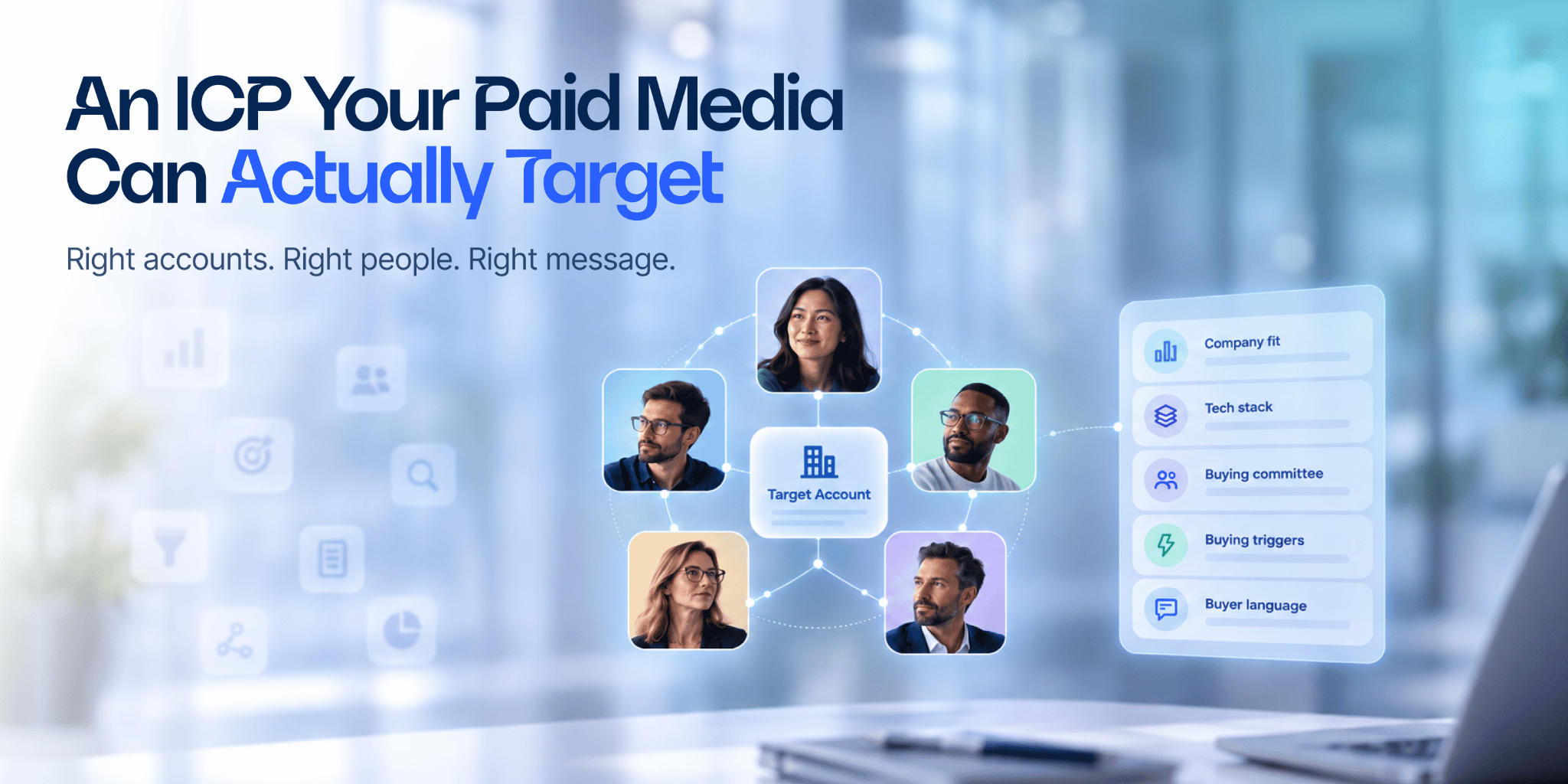
Building a B2B SaaS ICP That Paid Media Can Actually Target

A step-by-step framework for turning a vague B2B SaaS buyer persona into five targetable ICP inputs, mapped directly to LinkedIn and Google Ads targeting fields, with a fintech-specific breakdown included.

View
Articles
View
Articles
September 15, 2026

Google Ads vs LinkedIn Ads for B2B SaaS: Which Deserves the Next Dollar

Choosing a B2B SaaS agency or an in-house paid media hire is an 18-month cost question. See both sides of the model, with every assumption visible.

View
Articles
View
Podcast
September 18, 2026

The Human Side of Growth: Leadership and Building What Matters

In this episode of the Revenue Engine Podcast, Alex Gluz chats with Noah Fitzgerald, Chief Revenue Officer at Qredible, about leadership, growth, and building businesses that matter. Noah shares insights on founder challenges, customer-driven growth, and AI’s impact on business. He also discusses personal development, entrepreneurship, and lessons from building multiple ventures.

View
Podcast
View
Articles
September 15, 2026

Agency vs In‑House for B2B SaaS Paid Growth: The Real 18-Month Cost Model

Choosing a B2B SaaS agency or an in-house paid media hire is an 18-month cost question. See both sides of the model, with every assumption visible.

View
Articles
View
Podcast
September 4, 2026

How To Create a Category and Disrupt an Existing Market With Steve Keifer

Learn how a category creation strategy builds market awareness, earns buyer trust, and helps B2B companies disrupt entrenched competitors effectively.

View
Podcast
View
Video
August 26, 2026

Workshop: How Domain Names Are Being Redefined for the Next Era of the Internet

Identity Digital CRO Matt Overman joins Alex Gluz to unpack what hundreds of millions of domain registrations reveal about digital identity and the agentic web. The takeaway: domains are becoming sovereign identity anchors for humans and AI agents, and legacy .com gravity is giving way to meaningful, purpose-built extensions.

View
Video
View
Podcast
August 21, 2026

Modern Go-to-Market Leadership in the Age of AI With Eric Gilpin

Learn how AI go-to-market strategy helps SaaS teams adapt to buyer behavior, prove ROI, grow accounts, and build stronger customer relationships.

View
Podcast
View
Podcast
August 7, 2026

How B2B Brands Can Stand Out in a Crowded Market With Amanda Dyson

Learn how B2B brands can differentiate with a bold point of view, authentic content, strategic AI use, and marketing tied directly to pipeline.

View
Podcast
View
Video
July 17, 2026

Workshop: Events, Paid Media, and Pipeline Signals: The Technical B2B Marketing Playbook

Former Flosum VP Matt Lyman joins Alex Gluz to unpack marketing to technical audiences, the buyers who spot a weak message instantly. The takeaway: treat messaging as a hypothesis, make disciplined bets on events and paid media, and watch leading indicators before pipeline slips.

View
Video
View
Podcast
July 17, 2026

How Domain Names Are Shaping Digital Identity and AI Trust With Matt Overman

Learn how domain names strengthen digital identity, build online trust, and help brands and AI agents create more credible, verifiable interactions.

View
Podcast
View
Video
June 26, 2026

Workshop: How to Own Marketing, Product, and Partner Programs in One GTM Motion With Catherine Solazzo

Appfire's Catherine Solazzo joins Alex Gluz to break down what it actually means to run marketing beyond the traditional CMO scope, and why most B2B teams lose pipeline after the click. The takeaway: owning product documentation, partner programs, and customer experience gives marketing the context it needs to drive better GTM outcomes across the full funnel.

View
Video
View
Podcast
July 3, 2026

Should enterprise teams build or buy their AI marketing stack? With Eric Williamson

Build vs buy AI marketing technology: CallMiner CMO Eric Williamson on what enterprise teams should build, what to buy, and what they underestimate.

View
Podcast
View
Video
June 26, 2026

Workshop: Why Negative Sentiment Doesn't Predict Churn

Sturdy's Alex Atkins joins Alex Gluz to break down what 47 million B2B customer conversations reveal about churn, and why most teams are tracking the wrong signals. The takeaway: sentiment barely predicts churn, but signals like a contract request paired with an executive change can predict it nearly 80% of the time.

View
Video
View
Podcast
June 19, 2026

Building Effective Marketing Engines for Technical Audiences With Matt Lyman

Matt Lyman shares how marketers can earn technical buyers’ trust through targeted messaging, continuous testing, and data-driven growth.

View
Podcast
View
Articles
June 18, 2026

Generalist vs Specialist B2B SaaS Agency: 5 Key Reasons to Choose Niche

B2B SaaS specialists speed pipelines with custom ICPs and full teams. Skip generalist delays and freelancer risks. Discover why they win in this article.

View
Articles
View
Podcast
June 5, 2026

Building a CMO+ Mindset for Modern Marketing With Catherine Solazzo

Learn how a modern CMO drives growth by aligning product, marketing, and partner enablement to maximize revenue and customer engagement.

View
Podcast
View
Podcast
May 22, 2026

Why Customers Churn (And Why Most Teams Miss It)

Learn how customer churn signals reveal retention risks early and help B2B teams act faster before valuable accounts leave.

View
Podcast
View
Podcast
May 8, 2026

AI-Led, Human-Perfected Marketing Strategies With Nidhi Alexander

Alex Gluz is joined by Nidhi Alexander, Chief Marketing Officer and Executive Vice President at Hexaware Technologies, to discuss building AI-led, human-perfected marketing strategies.

View
Podcast
View
Podcast
April 24, 2026

AI, Data, and Human Touch in SaaS With Ben Chodor

Alex Gluz is joined by Ben Chodor, CEO of CallRevu, to discuss the evolving role of AI, data, and human connection in SaaS growth. Ben explains how AI is reshaping service and support, why data-driven marketing must go beyond vanity metrics, and how alignment across teams drives revenue. He also talks about adapting leadership as companies scale.

View
Podcast
View
Podcast
April 10, 2026

Future-Proofing Revenue Engines Using AI With Parry Bedi

Alex Gluz is joined by Parry Bedi, Co-founder and CEO of Tingono, to discuss how AI is reshaping revenue engines. They explore probabilistic versus deterministic systems, using AI to predict churn and drive retention, and why traditional SaaS workflows need a complete overhaul.

View
Podcast
View
Podcast
March 27, 2026

Cybersecurity Marketing: Building Trust Instead of Fear

Alex Gluz is joined by Dhiraj Kumar, Chief Marketing Officer at Dashlane, to discuss how cybersecurity brands can build trust instead of relying on fear. They explore balancing risk awareness with empowerment, translating complex tech into business outcomes, and focusing demand generation on the right audience. Dhiraj also shares advice on leveraging customer advocacy and first-party data.

View
Podcast
View
Articles
March 20, 2026

B2B Marketing Trends 2026: What's Actually Changing (and What to Do About It)

Sales cycles are averaging 11.5 months. Buying committees have grown to 10+ stakeholders. Here's how B2B marketers are adapting in 2026.

View
Articles
View
Podcast
March 13, 2026

Scaling a Startup and Building a High-Velocity Revenue Engine With Matt Shephard

Alex Gluz is joined by Matt Shephard, Chief Revenue Officer at BatchData, to discuss how to scale a startup and build a high-velocity revenue engine. They explore identifying the right ICP, simplifying sales for practical buyers, and aligning marketing and sales around shared accounts. Matt also shares advice on signal-based go-to-market strategies and why timing is becoming the most important advantage in modern sales.

View
Podcast
View
Podcast
February 27, 2026

How do payments companies market to their customers? With Jenn Reichenbacher

How do payments companies market to their customers? Stax’s Jenn Reichenbacher on winning trust in a category that trained buyers to expect hidden fees.

View
Podcast
View
Podcast
February 13, 2026

Bridging the Gap Between B2C Creativity and B2B Effectiveness With Rodrigo Fontes

Rodrigo Fontes shares how B2B marketers can use B2C creativity, AI, and attention-driven strategies to build brand awareness and drive growth.

View
Podcast
View
Podcast
January 30, 2026

Building Revenue Engines in the Restaurant Technology Space With Tara Clever

Tara Clever is the Chief Revenue Officer at MarginEdge, a restaurant management and bill payment platform that leverages automation and AI to streamline restaurant operations. Under her leadership, MarginEdge has marked its 10-year anniversary by reaching major milestones, including onboarding its 10,000th restaurant customer and expanding its AI-powered product offerings. Tara brings a unique blend of sales, operations, and marketing experience, with a background in DTC and B2B growth, and focuses on customer-centric alignment and operational clarity to drive scalable go-to-market outcomes.

View
Podcast
View
Podcast
January 16, 2026

Building a Revenue Culture Rooted in Transparency and Alignment With Angela Earl

Angela Earl is the Head of Marketing at Darrow AI, a B2B SaaS company specializing in leveraging artificial intelligence to deliver actionable insights and drive revenue growth for technology organizations. With over 20 years of experience in the tech sector, Angela is a seasoned go-to-market leader who has built high-performing teams and contributed to the success of multiple high-growth software companies. As an author and advisor, she focuses on culture, transparency, and revenue performance, and often emphasizes the importance of communication and trust in achieving organizational goals.

View
Podcast
View
Podcast
December 19, 2025

Harnessing Trust, Personal Branding, and AI To Accelerate Growth

Alex Gluz reflects on his insightful conversations with Mark Stiltner, Patrick Ferdig, Sylvia LePoidevin, Kristin Oelke, and Usman Sheikh.

View
Podcast
View
Articles
December 9, 2025

How to Use MQL and SQL Data to Prove SaaS Marketing ROI

Learn how leading B2B SaaS marketers and agencies use MQL and SQL data to connect campaigns to qualified pipeline and real ROI. Practical frameworks, benchmarks, and actionable examples inside.

View
Articles
View
Podcast
October 17, 2025

Uniting Sales and Marketing to Supercharge B2B Revenue With Alex Tinsley

In this episode of The Revenue Engine Podcast, host Alex Gluz chats with Alex Tinsley of SUSE on how aligning sales and marketing boosts B2B revenue. They discuss breaking silos, improving handoffs, and building trust through empathy, structure, and transparency.

View
Podcast
View
Podcast
December 5, 2025

Revolutionizing Real-Time Customer Feedback and Operational Transformation With Steven Peltzman

Discover how Steven Peltzman of FeedbackNow uses real-time customer feedback sensors to transform operations, boost satisfaction, and drive measurable revenue.

View
Podcast
View
Podcast
November 21, 2025

How do you attribute B2B pipeline to marketing? With Brandon Rhoten

B2B marketing attribution: former GroundTruth CMO Brandon Rhoten on tying campaigns to pipeline, testing the model, and the blind spot AI search opened.

View
Podcast
View
Podcast
November 7, 2025

Unlocking the Real Impact of Product Marketing in B2B SaaS With Jona Youdeem

Discover the real impact of product marketing in B2B SaaS with Jona Youdeem as he reveals how strategy, insights, and AI drive lasting growth.

View
Podcast
View
Articles
October 31, 2025

The B2B SaaS ROI Playbook: How CMOs Prove Impact When Budgets Are Tight

Learn how B2B SaaS CMOs are proving marketing ROI, optimizing spend, and driving growth despite tighter budgets with data-backed strategies.

View
Articles
View
Podcast
October 3, 2025

Turning Marketing From a Cost Center Into a Growth Engine With Jeff Baker

In this episode of the Revenue Engine Podcast, host Alex Gluz speaks with Jeff Baker, Senior Director of Global Marketing at smartShift, to discuss turning marketing from a cost center into a growth engine.

View
Podcast
View
Podcast
September 19, 2025

How Community-Led Marketing Drives Sustainable B2B SaaS Growth With Derek Weeks

In this episode of the Revenue Engine Podcast, host Alex Gluz sits down with Derek Weeks, Chief Marketing Officer at Katalon, to discuss how community-led marketing drives sustainable B2B SaaS growth

View
Podcast
View
Articles
September 24, 2025

When to Outsource vs. Build In-House: Balancing Resources to Optimize SaaS Marketing ROI

Learn how successful SaaS companies balance outsourced and in-house marketing. Includes comparison tables, common pitfalls, and hybrid team management strategies.

View
Articles
View
Articles
July 22, 2025

Proven Strategies to Lower B2B SaaS Customer Acquisition Costs in 2025

Cut your B2B SaaS marketing costs with this comprehensive B2B funnel optimization guide. Reduce CAC, optimize conversion rates, and accelerate growth.

View
Articles
View
Podcast
September 5, 2025

What Should a B2B SaaS Company Spend on Marketing? With Christine Royston of Wrike

Wrike CMO Christine Royston on how to size a marketing budget, what agencies actually charge in 2026, and how to defend the number in front of a CFO.

View
Podcast
View
Podcast
August 15, 2025

Fixing Broken B2B Sales Workflows With AI-Powered Strategies With Usman Sheikh

Discover how AI-powered strategies can fix broken B2B sales workflows, boost efficiency, and improve conversion rates with Usman Sheikh.

View
Podcast
View
Podcast
August 1, 2025

How Trust Is Key to Growth in Today’s AI World With Kristin Oelke

In this episode of the Revenue Engine Podcast, host Alex Gluz is joined by Kristin Oelke, Managing Director for Growth Services at Brightrose Ventures, to talk about why trust is more important than ever for growth in today’s AI-driven world.

View
Podcast
View
Podcast
July 18, 2025

Balancing Brand and Performance Marketing in B2B SaaS With Mike Braund

In this episode of the Revenue Engine Podcast, host Alex Gluz sits down with Mike Braund, Senior Director of Marketing Operations and Digital Marketing at Iterable, to discuss how to align brand and performance marketing in B2B SaaS.

View
Podcast
View
Podcast
July 4, 2025

Building Trust and Standing Out in Saturated Markets With Ani Obermeier

In this episode of the Revenue Engine Podcast, host Alex Gluz sits down with Ani Obermeier, Board Advisor at WorkBuzz, to talk about building trust and standing out in saturated markets.

View
Podcast
View
Podcast
June 6, 2025

How Do You Define an Ideal Customer Profile for B2B SaaS? With Former Recurly CRO, Nick Naso

Former Recurly CRO, Nick Naso, on why most lead quality arguments are really ICP arguments, and how often you should be rewriting the definition.

View
Podcast
View
Podcast
June 20, 2025

Reinventing Modern B2B Marketing Through Branding, Community, and AI With Sylvia LePoidevin

In this episode of the Revenue Engine Podcast, host Alex Gluz sits down with Sylvia LePoidevin, CMO at Kandji, to talk about reinventing modern B2B marketing through branding, community, and AI.

View
Podcast
View
Podcast
May 23, 2025

The Five Pillars of Partnership Success With Patrick Ferdig

In this episode of the Revenue Engine Podcast, host Alex Gluz speaks with Patrick Ferdig, Founder and Principal Consultant at The Power of Partnering, to discuss the five pillars of partnership success. They explore why trust drives results, how alignment shapes execution, and what businesses must prioritize to turn partners into revenue engines. Patrick also gives advice on scaling outreach using AI tools.

View
Podcast
View
Articles
May 2, 2025

AI in B2B SaaS Marketing: How It’s Reshaping Strategy, Content & Customer Experience

Whether you're just exploring automation or already experimenting with tools like GPT-4 or Jasper, this guide breaks down how AI is transforming every stage of the B2B SaaS funnel.

View
Articles
View
Podcast
May 9, 2025

Building an AI-Driven Content Engine With Mark Stiltner

In this episode of the Revenue Engine Podcast, host Alex Gluz speaks with Mark Stiltner, Senior Director of Content and Web Marketing at Rapyd, to talk about building an AI-powered content strategy. They discuss weaving AI into SEO workflows, shifting from traditional search optimization to AI model visibility, and balancing automation with creativity. Mark also shares practical ways to future-proof marketing teams in an AI-driven landscape.

View
Podcast
View
Podcast
April 18, 2025

Why Are Our B2B SaaS Leads Not Converting? With Bethany Prettyman

Usually the funnel model is wrong, not the leads. Bethany Prettyman on loop models, tracking intent and velocity instead of MQLs, and what to fix first.

View
Podcast
View
Video
April 14, 2025

Interview: The Biggest Challenges in B2B SaaS Marketing with Alex Gluz

B2B SaaS companies face significant challenges in today's market environment. Dr. Jeremy Weisz of Rise25 interviews Alex Gluz. They discuss the most pressing challenges in B2B SaaS marketing and practical approaches to overcome them.

View
Video
View
Podcast
April 4, 2025

Making Cybersecurity Simple, Scalable, and Phishing Resistant With Ronnie Manning

Ronnie Manning is the Chief Brand Associate at Yubico, a global cybersecurity company renowned for inventing the YubiKey, which offers phishing-resistant multi-factor authentication solutions. With over 20 years of experience in agency and corporate communications, he has focused on public relations and marketing strategies to bring new technology products to market. Prior to joining Yubico, Ronnie held positions at Raytheon/Websense and Edelman Public Relations. At Yubico, he has been instrumental in promoting the adoption of hardware-based authentication solutions and advocating for enhanced cybersecurity measures.

View
Podcast
View
Articles
July 27, 2026

The Ultimate B2B SaaS Demand Generation Playbook for 2026: Building Sustainable Growth Through Brand, Product, and Community

Gain actionable insights and access to practical tools designed to build a robust and sustainable demand engine that will thrive in 2026 and beyond.

View
Articles
View
Podcast
March 14, 2025

What is B2B demand generation, and how does buyer psychology drive it? With Kerry Rana

What is B2B demand generation? ExtraHop’s Kerry Rana on the eight components of a plan that works and why buyer psychology decides if it lands.

View
Podcast
View
Video
April 2, 2025

Workshop: The Blueprint for Marketing & Sales Alignment With Michael Tucker

Alex Gluz and Michael Tucker of Rocky Mountain Revops share a framework to fix broken marketing-sales systems. Michael explains architecture mapping to visualize and optimize the buyer's journey across channels and sales stages.

View
Video
View
Articles
January 9, 2025

Unlocking Event Success: How Paid Media Strategies Drive High-Impact Outcomes for SaaS Event Marketing

In the competitive SaaS event marketing space, leveraging paid media strategies is essential. As economic pressures and technological advancements reshape the industry, adopting innovative approaches helps maximize ROI and stand out.

View
Articles
View
Podcast
January 31, 2025

Purpose vs. Mission: Building Brands That Inspire With Dave Minifie

In this episode of the Revenue Engine Podcast, Alex Gluz sits down with Dave Minifie, Chief Marketing Officer at Terakeet, to discuss how companies can build purpose-driven brands. Dave breaks down the difference between mission and purpose, explains how a clear purpose fuels customer engagement and growth, and explores the impact of AI and search engines on brand visibility. He also shares insights on navigating leadership transitions and staying ahead in a changing marketing landscape.

View
Podcast
View
Podcast
January 21, 2025

The Biggest Challenges in B2B SaaS Marketing and How To Approach Them

In this episode of the Revenue Engine Podcast, Dr. Jeremy Weisz from Rise25 interviews Alex Gluz to discuss the biggest challenges in B2B SaaS marketing and actionable strategies to address them. Together, they explore how marketers can navigate prolonged sales cycles, optimize acquisition costs, and differentiate their offerings in a saturated market. Alex also shares how personalization, thought leadership, and customer retention can be game changers for driving growth.

View
Podcast
View
Podcast
December 20, 2024

Building Growth Engines: Data, Compliance, and Customer Success Highlights

In this episode of the Revenue Engine Podcast, Alex Gluz reflects on his impactful conversations with Kathleen Booth, Rich Liu, Sam Li, Hunter Montgomery, and Usman Sheikh. These industry leaders unpack the power of data-driven decisions, the evolving compliance landscape, and the role of customer success in building growth engines that thrive in today’s dynamic market.

View
Podcast
View
Podcast
December 6, 2024

The Power of Long-Term Strategy in B2B Marketing With Katrine Rasmussen

In this episode of the Revenue Engine Podcast, Alex Gluz is joined by Katrine Rasmussen, Chief Marketing Officer at Pixelz, to discuss how long-term strategy shapes success in B2B marketing. They explore the nuances of managing extended sales cycles, the role of digital and in-person engagement in enterprise marketing, and the importance of differentiating your brand in a crowded market. Katrine also gives advice on scaling community building and thought leadership efforts to drive meaningful impact.

View
Podcast
View
Podcast
November 8, 2024

Building Resilient Teams and Driving Data-Driven Growth With Russ Hawkins

In this episode of the Revenue Engine Podcast, host Alex Gluz sits down with Russ Hawkins, President and CEO of Agilence, to discuss how he’s built resilient teams and driven data-powered growth throughout his career. Russ shares his insights on fostering a collaborative company culture, making strategic shifts to adapt to market demands, and the critical role of data in driving revenue growth. He also gives advice on avoiding common pitfalls in scaling.

View
Podcast
View
Podcast
November 1, 2024

RevOps Made Simple With Michael Tucker

In this episode of the Revenue Engine Podcast, host Alex Gluz sits down with Michael Tucker, Founder and Head Systems Architect at Rocky Mountain RevOps, to discuss simplifying RevOps strategies for maximum impact.

View
Podcast
View
Podcast
October 18, 2024

Agility in B2B Marketing With Ashley Widener

In this episode of the Revenue Engine Podcast, host Alex Gluz speaks with Ashley Widener, Director of Marketing at GoCo, to discuss how agility fuels success in B2B marketing. Ashley explains how building a marketing team from scratch allowed her to create a nimble, responsive approach.

View
Podcast
View
Podcast
October 4, 2024

Mastering Customer-Centric Marketing Strategies With Samantha Bergin

In this episode of the Revenue Engine Podcast, host Alex Gluz sits down with Samantha Bergin, Chief Marketing Officer at Center, to discuss mastering customer-centric marketing strategies.

View
Podcast
View
Articles
October 18, 2024

How Regular Negative Keyword Updates Improve Your B2B SaaS Ad Campaigns on Google

It’s no secret that in the B2B SaaS space, regularly optimizing Google Ads campaigns for maximum efficiency is essential. But, there’s one key strategy that is often overlooked—keeping your negative keyword list up to date.

View
Articles
View
Articles
October 10, 2024

The ROI of LinkedIn Ads: Spending Smarter, Not More

As marketers in the B2B SaaS space, one of the most common challenges with LinkedIn Ads is ensuring that your budget is fully utilized without overpaying for traffic. While LinkedIn offers access to high-quality leads, it’s easy to blow through your budget if you’re not careful.

View
Articles
View
Podcast
September 20, 2024

Balancing Innovation and Resource Management in Startup Marketing With Caroline Ang Wright

In this episode of the Revenue Engine Podcast, host Alex Gluz sits down with Caroline Ang Wright, Head of Marketing at Exodigo, to discuss building and leading marketing strategies in a startup landscape.

View
Podcast
View
Articles
October 3, 2024

The ROI of Intent Data: Measuring Success in B2B SaaS Marketing

As a B2B SaaS company, leveraging intent data has become an important action item in driving efficient growth and acquiring high-value customers. But how do you quantify its impact and prove its worth?

View
Articles
View
Podcast
September 6, 2024

Simplifying Complex Customer Journeys Through CXM With Sherri Schwartz

In this episode of the Revenue Engine Podcast, host Alex Gluz sits down with Sherri Schwartz, Head of Marketing at OvationCXM, to discuss how to simplify complex customer journeys through CXM.

View
Podcast
View
Articles
September 26, 2024

LinkedIn Ad Budgeting: Making Sense of CPM and CPC in 2024

When it comes to B2B marketing, it’s no secret that LinkedIn continues to be a powerhouse platform for reaching decision-makers and professionals. But as the end of 2024 nears, one question looms: How can we optimize our ad spend on LinkedIn to maximize ROI?

View
Articles
View
Articles
September 12, 2024

The 'Less is More' Approach: Simplifying Your B2B Strategy for Rapid Growth

B2B marketers often fall into the trap of doing more — more campaigns, more content, more channels — all in pursuit of growth. However, this can lead to diluted efforts, resource strain, and diminished returns.

View
Articles
View
Articles
September 19, 2024

Cognitive Triggers in LinkedIn Advertising: A B2B Marketer's Guide

It’s no secret that in B2B marketing, LinkedIn stands out as a powerful platform for reaching decision-makers and professionals. But what you might not know is: Understanding the cognitive triggers behind LinkedIn ads can significantly boost your campaign performance and ROI.

View
Articles
View
Articles
September 5, 2024

Measuring and Optimizing Customer Lifetime Value in B2B

When it comes to B2B SaaS, the path from initial contact to loyal customer is both challenging and rewarding. As ‘bigger and better’ solutions continue to reshape the business landscape, one element remains crucial — the ability to nurture and convert leads effectively.

View
Articles
View
Podcast
August 16, 2024

Cultivating Top-Tier Sales and Marketing Alignment in Real Estate Tech With Amanda Sullivan

In this episode of the Revenue Engine Podcast, host Alex Gluz sits down with Amanda Sullivan, the Vice President of Growth at Sierra Interactive, to discuss the art of cultivating top-tier sales and marketing alignment in real estate tech

View
Podcast
View
Articles
August 29, 2024

From Stranger to Customer: Mapping the B2B SaaS Lead Warming Journey

When it comes to B2B SaaS, the path from initial contact to loyal customer is both challenging and rewarding. As ‘bigger and better’ solutions continue to reshape the business landscape, one element remains crucial — the ability to nurture and convert leads effectively.

View
Articles
View
Podcast
August 2, 2024

The Power of Modern Market Intelligence With Greg Munves

In this episode of the Revenue Engine Podcast, host Alex Gluz sits down with Greg Munves, CEO of OpenBrand, to discuss the power of modern market intelligence.

View
Podcast
View
Articles
August 22, 2024

5 Essential Steps to Align Sales and Marketing in High-Growth B2B SaaS Companies

A rapidly evolving B2B SaaS landscape awaits, where innovative solutions and disruptive technologies are continuously reshaping the way businesses operate. In this environment, one element stands tall, guiding companies toward consistent growth and long-term success: The seamless alignment of Sales and Marketing teams.

View
Articles
View
Articles
August 15, 2024

Getting Personal: How to Create a Meaningful Customer Experience in Today's Digital-First World

It’s not news that we’re constantly being dominated by digital interactions. Creating a personal customer experience isn't just a nice-to-have — it's a crucial differentiator that sets your brand apart.

View
Articles
View
Articles
August 8, 2024

The Power of Retargeting: Strategies for LinkedIn and Search Ads

Launching a new product successfully can mean the difference between market leadership and obscurity. A well-executed product launch not only introduces your offering to the world but also sets the stage for long-term success.

View
Articles
View
Podcast
July 19, 2024

Optimizing Customer Marketing With Data-Driven Techniques With Hunter Montgomery

In this episode of the Revenue Engine Podcast, host Alex Gluz sits down with Hunter Montgomery, Chief Marketing Officer at ChurnZero, to discuss optimizing customer marketing with data-driven techniques.

View
Podcast
View
Articles
July 24, 2024

Social Media Advertising: 2024 Trends and Best Practices

Launching a new product successfully can mean the difference between market leadership and obscurity. A well-executed product launch not only introduces your offering to the world but also sets the stage for long-term success.

View
Articles
View
Articles
August 1, 2024

LinkedIn vs. Facebook Ads: Which is Right for Your B2B SaaS?

Launching a new product successfully can mean the difference between market leadership and obscurity. A well-executed product launch not only introduces your offering to the world but also sets the stage for long-term success.

View
Articles
View
Articles
July 18, 2024

How to Create an Effective Go-to-Market Plan

Launching a new product successfully can mean the difference between market leadership and obscurity. A well-executed product launch not only introduces your offering to the world but also sets the stage for long-term success.

View
Articles
View
Podcast
July 5, 2024

What does B2B SaaS paid media look like without third party cookies? With Mark McEachran

How B2B SaaS paid media strategy works without third party cookies: first party data, contextual targeting and pipeline measurement, with Mark McEachran.

View
Podcast
View
Podcast
June 21, 2024

Mastering Go-to-Market Strategies and Customer Retention With Brian Warrick

In this episode of the Revenue Engine Podcast, host Alex Gluz sits down with Brian Warrick, Revenue Leader at Baresquare, to discuss mastering go-to-market strategies and customer retention.

View
Podcast
View
Podcast
June 7, 2024

The AI Advantage: Unlocking the Power of Data Science in Marketing With Jon Morra of Zefr

In this episode of the Revenue Engine Podcast, host Alex Gluz sits down with Jon Morra, the Chief AI Officer at Zefr, to discuss how AI is revolutionizing marketing.

View
Podcast
View
Articles
June 19, 2024

The Power of Data-Driven Marketing: How to Leverage Analytics for Growth

As a B2B SaaS company in today's digital landscape, you can't afford to rely on guesswork when it comes to your marketing efforts. The key to driving sustainable growth and staying ahead of the competition? Data-driven marketing powered by comprehensive analytics.

View
Articles
View
Podcast
May 24, 2024

The Data-Driven Guide to Thriving in a Hybrid Work Environment With Rob Sadow

In this episode of the Revenue Engine Podcast, host Alex Gluz sits down with Rob Sadow, CEO and Co-founder of Scoop, to discuss the intricacies of hybrid work.

View
Podcast
View
Podcast
May 10, 2024

Marketing and Growing as a Compliance Company With Sam Li of Thoropass

In this episode of the Revenue Engine Podcast, Alex Gluz sits down with Sam Li, the CEO and Founder of Thoropass, to discuss the secrets of marketing.

View
Podcast
View
Podcast
April 26, 2024

Invaluable Lessons From a Marketing Executive With Kathleen Booth of Pavilion

In this episode of the Revenue Engine Podcast, Alex Gluz interviews Kathleen Booth, the Senior Vice President of Marketing and Growth at Pavilion, to discuss some of her greatest insights into digital marketing.

View
Podcast
View
Podcast
March 1, 2024

Humanizing B2B Sales and Marketing Through AI With Usman Sheikh of xiQ

In this episode of the Revenue Engine Podcast, Alex Gluz interviews Usman Sheikh, the Founder and CEO of xiQ, to break down the process of personalizing sales. They talk about the power of AI to connect with customers, understanding the behavioral code in people, and making your mark in an oversaturated market. They also explain the way to maximize email marketing and where the field is heading in the future.

View
Podcast
View
Podcast
April 12, 2024

Identifying and Overcoming Challenges With Quentin Kasseh of Nomad Engineers Consulting Group

In this episode of the Revenue Engine Podcast, Alex Gluz has a conversation with Quentin Kasseh, Founder of Nomad Engineers Consulting Group, about overcoming marketing and business challenges.

View
Podcast
View
Podcast
March 29, 2024

A Coach’s Advice for Startups and Founders With Dane Holewinski of Decode Coaching

In this episode of the Revenue Engine Podcast, Alex Gluz interviews Dane Holewinski, the Founder and CEO Coach at Decode, to discuss a coach’s tips and strategies for startup founders.

View
Podcast
View
Podcast
March 15, 2024

Marketing Companies From Startups to IPO With Rich Liu of Everlaw

In this episode of the Revenue Engine Podcast, Alex Gluz interviews Rich Liu, the Chief Business Officer at Everlaw, to discuss marketing at different stages of growth. The two break down the current marketing landscape with AI, lessons learned from switching to digital marketing, and how to use funding at an early stage.

View
Podcast
View
Podcast
January 19, 2024

Developing and Marketing Technology Products With Dylan Serota of Terminal.io

In this episode of the Revenue Engine Podcast, Alex Gluz talks with Dylan Serota, the CEO and Co-founder of Terminal.io, about marketing and optimizing technology products. They discuss engineering resilience, identifying clients, AI in tech products, and how Dylan would utilize startup funding if he were to do it again.

View
Podcast
View
Podcast
February 16, 2024

Managing and Optimizing Multi-Channel Campaigns With Frederik Hermann of Beekeeper

In this episode of the Revenue Engine Podcast, Alex Gluz talks with Frederik Hermann, the Vice President of Digital Marketing at Beekeeper, to discuss multi-channel campaigns and how to manage teams. They walk through thought leadership, pipeline growth, and leveraging modern marketing technology. They also touch on the newest opportunities for marketers in 2024.

View
Podcast
View
Articles
February 5, 2024

Identifying Blindspots: Hidden Demand Gen Costs Stunting Your Growth

For B2B SaaS companies, meeting revenue growth goals depends heavily on having an effective demand-generation engine. But all too often, there are hidden costs sabotaging demand gen efforts behind the scenes.

View
Articles
View
Podcast
January 5, 2024

Driving Sustainable and Predictable Growth With Michael Krause of Tovuti LMS

In this episode of the Revenue Engine Podcast, Alex Gluz interviews Michael Krause, the COO and Chief Growth Officer at Tovuti LMS, on the best practices for sustainable growth.

View
Podcast
View
Articles
January 10, 2024

Overcoming the «Limited Marketing Budget» Challenge

LinkedIn advertising presents a major opportunity for B2B SaaS companies looking to generate quality leads and accelerate growth. With over 930 million members, LinkedIn provides access to a massive professional audience. However, simply creating a few basic Sponsored Content ads is not enough to cut through the noise on this crowded platform.

View
Articles
View
Podcast
December 22, 2023

Product Marketing to B2B, B2C, and B2G With Nitin Kartik of Carbyne

In this episode of the Revenue Engine Podcast, Alex Gluz sits down with Nitin Kartik, the Director of Product Marketing at Carbyne, to discuss the differences in marketing B2B, B2C, and B2G.

View
Podcast
See all posts

More Resources

Google Search Ads Benchmarks Report

Learn why your search ads cost more and convert less (and what to do about it).

Download Now

5 Must-Know 2026 B2B Marketing Trends

Five trends shaping B2B SaaS pipeline generation in 2026, and the one move to make on each. A fast way to check your current strategy against what's actually working now.

Download Now

2026 AI Buyer Effect Field Guide

Buyers ask an AI tool instead of clicking through your funnel. This guide shows where that shows up first in your account, and what to do about it.

Download Now

The Competitor Teardown Skill

Point it at any competitor URL. Get their positioning gaps, the buyers they've written off, and the one line that wins the deal.

Download Now

AI Marketing Strategies Playbook: How 5 Marketing Leaders Cracked the AI Code

How 5 Marketing Leaders Cracked the AI Code.

Download Now

B2B SaaS Persona Builder

Copy & Paste prompt for ChatGPT.

Download Now

B2B SaaS LinkedIn Targeting Blueprint

How to drive qualified leads in under 7 days using LinkedIn’s targeting capabilities (including account-based marketing).

Download Now

Explore Proven Formulas for High‑Impact LinkedIn Ads

LinkedIn Ads Swipe File.

Download Now

Creating a Complete Full-Funnel Strategy for Predictable Revenue Growth

Download Now

How to Stop Overpaying for Your Branded Google Ads Keywords

The Ultimate Branded Google Ads Optimization Guide.

Download Now

The 2026 Ultimate Revenue Engine Blueprint

Your guide to standing out in crowded markets without overspending on ads. Covers branding, PLG triggers, and community tactics in one concise playbook.

Download Now

5 Tips To Find Success on Google Ads

Download Now

7 High-ROI Google Ads Optimization Tips & Strategies + Bonus Checklist

Download Now

Improve Your MQL Quality in 90 Days Cheat Sheet

In this cheat sheet, you’ll learn the top hacks to get more marketing‑qualified leads for your sales funnel.

Download Now

4 Secrets for Running Paid Social Ads That You’re Not Supposed to Know

Download Now

Discover the 7 Essential Steps for an Effective Go-to-Market Strategy

Download Now

B2B SaaS Revenue Growth Checklist

If your revenue engine falls short of expectations, this checklist will help you quickly identify and address the underlying issues.

Download Now

LinkedIn Targeting Cheat Sheet

Four targeting layers, three ABM moves, and a 48-hour launch timeline. One page, actionable today.

Download Now

2026 Reddit Prelaunch Targeting Guide

No wasted spend, no setup surprises. Get your Reddit targeting right before you go live.

Download Now

LinkedIn Ads Benchmarks Report 2026

The 2026 LinkedIn benchmarks B2B marketing teams use to lower CPLs and protect budget. Format-level data across four formats, two regions, and three industries.

Download Now

2026 B2B Marketing Trends Report

What leading B2B marketers are prioritizing in 2026. The trends, data, and tactics to sharpen your strategy.

Download Now
See all free resources
Revenue Engine Newsletter

Get B2B Marketing & Growth Insights

Our SaaS-focused frameworks help you scale qualified pipeline and accelerate revenue growth.

Thank you! Your submission has been received!
Oops! Something went wrong while submitting the form.
T.A. Monroe logo, white version
Google Premier Partner 2026
Address:
7284 West Palmetto Park Road, Suite 101, Boca Raton, Fl 33433
Contact:
+1 (646) 844-9480
support@tamonroe.com
ServicesCase StudiesAbout UsCareersContact
Resource HubPodcastArticlesVideoLibrary
Copyright © 2026 – T.A. Monroe Digital Agency
Privacy Policy