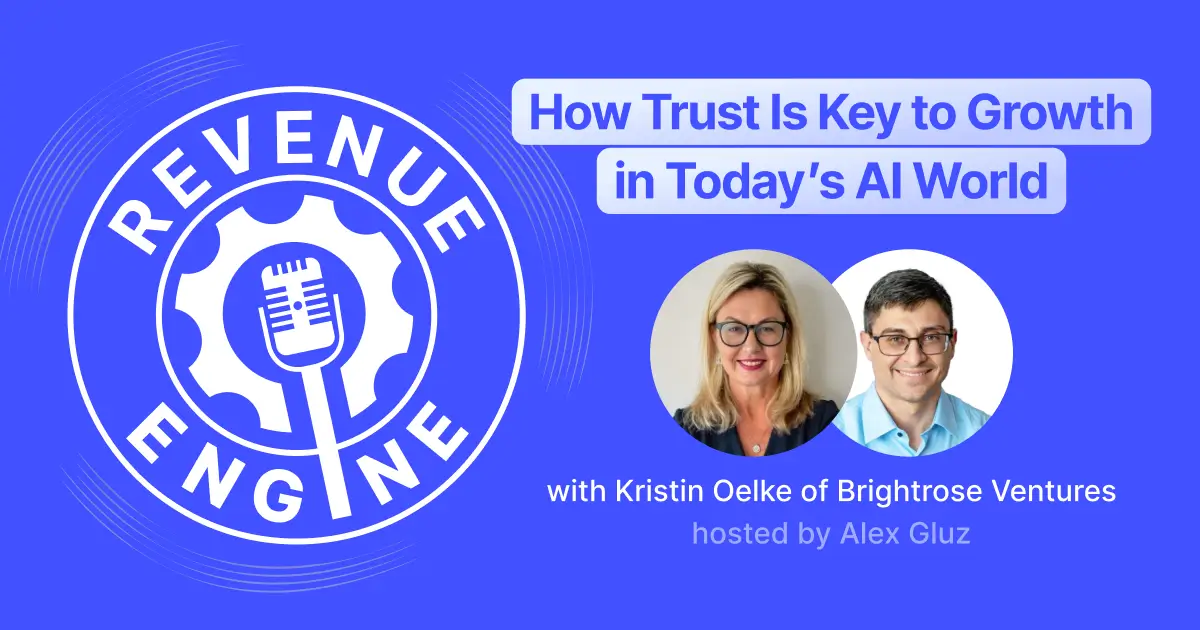
Introduction and Kristin Oelke’s path into B2B marketing
Alex Gluz: We have a great guest for you today. Kristin, nice to have you here. How are you?
Kristin Oelke: I’m great. Thanks for having me.
Alex Gluz: Delighted to have you here. Can you do a brief intro of who you are and what you do?
Kristin Oelke: I am Kristin Oelke. I am the Managing Director for Growth Services for Brightrose Ventures. Brightrose Ventures is an advisory and investment firm for B2B business software companies.
Alex Gluz: Great. How did you get started, Kristin? What did you go to school for?
Kristin Oelke: I went to school in the area of communications. I’ve always been a huge reader of nonfiction, so I started with journalism as my undergrad, communications as my master’s.
Kristin Oelke: I’ve always been very interested in consuming and producing content, nonfiction content.
Alex Gluz: What did you like to write about?
Kristin Oelke: Current events, pop culture, history. Then it evolved into business.
Alex Gluz: What was one of your early jobs in B2B marketing?
Kristin Oelke: I got super lucky. When the tech boom was really taking off, I started with a company called Sun Microsystems, which was one of the big names early on.
Kristin Oelke: I started in their Chicago office as a field marketer. That’s where I started to connect communications with revenue, and that’s really where my career started to take off.
Why trust matters when the pipeline stalls
Alex Gluz: When we chatted before our interview, we were discussing quite a lot about your book. I think it’s really interesting, and it’s really captivating.
Alex Gluz: The name of the book is Trust: Unlocking B2B Growth in Today’s AI World. Check this out. It tackles the important issue of trust and B2B buying patterns. Let’s talk about that.
Kristin Oelke: What really got me thinking about this was at the advent of AI. I had a client at the time who, as you know from your company and your role, you would be very familiar with this, had solid pipeline, but it wasn’t advancing.
Kristin Oelke: It really got me starting to think: how is AI impacting this, and why is this pipeline not progressing?
Kristin Oelke: It had to do with this lack of customer trust. It was an early-stage business, hadn’t built up its trust profile, didn’t have all the customer stories, all the proof points that are necessary to build that trust to advance people, particularly in the enterprise space.
Kristin Oelke: You’re having to influence so many people in the buying cycle that you need to have the financial value proposition, the technical value proposition, the business, how it’s going to make productivity better.
Kristin Oelke: When the business doesn’t have that and doesn’t have third-party validation, it could be customers, partners, analysts, that mid-funnel gets stuck.
Kristin Oelke: AI only made that worse because it was all this noise in the market, and people didn’t know who to believe.
Kristin Oelke: That was really the genesis of this book. It’s about how any business, and frankly us as even individual brands, how do we let the world know, through the lens of others who are trusted, of our value?
Alex Gluz: This is really interesting. In B2B, the middle of the funnel, if you think about awareness, consideration, conversion, the consideration, that’s the most important part.
Alex Gluz: These people are aware of the problem. They’re aware of the solution. But now they need to build the case.
Alex Gluz: This is where it’s very important to be able to relate to them, to showcase: we were able to solve a similar problem for similar types of clients. That goes a long way.
Alex Gluz: If you’re in banking and have a certain problem, and then you see a similar bank, “We do have a similar problem. We do know this bank, and they’re similar to us. You probably can solve it for us as well.”
Alex Gluz: It goes on many different levels.
Building a public trust profile through feedback and proof
Alex Gluz: One of the more interesting things you mentioned in your book is the concept of a public trust profile. Could you elaborate on how businesses can actively build and manage this profile to accelerate their revenue growth?
Kristin Oelke: Of course. You can do it through a variety of ways. We recommend to the clients we work with that you assess your reputation, your trust profile, through a variety of means.
Kristin Oelke: You can do standard surveys. You can do social listening. You can make sure you have consistency of messaging across all of your business.
Kristin Oelke: What we also find sometimes is that you have marketing saying one thing, sales saying another and support saying something else. That builds distrust.
Kristin Oelke: Part of it is listening and that feedback into your business. But then it’s also what are you projecting out?
Kristin Oelke: One of the clients I have right now is doing something super interesting and really transformative in this space around real-time feedback.
Kristin Oelke: You know how there’s a delay with surveying and NPS scores? By the time you get that, your buyer, your prospect, your audience has already built up their thinking around you, hopefully positively, but maybe negatively, and you can’t react fast enough to it.
Kristin Oelke: FeedbackNow is a real-time experience platform. Have you seen in hospitals or airports or retail stores where you see the smileys, the red, green, yellow?
Kristin Oelke: Behind that is an amazing amount of data, but it’s also a trigger into the operational infrastructure of these businesses. It immediately triggers a better on-site experience because, as a customer, you’re letting the people know who can do something about it immediately.
Kristin Oelke: You’re in that environment, whether it be a hospital, if you’re a patient or a caregiver for the patient, or if you’re in a retail store and you’re shopping.
Kristin Oelke: We’re seeing some transformation in this space around how you get that feedback and the immediacy of how you get it so that you can more rapidly address it. Therefore, your trust profile goes up.
Kristin Oelke: There’s a common-sense disposition to most people that things can go wrong. But if you can address when things aren’t right faster, that trust profile will be fine.
Kristin Oelke: It’s when it goes on for a while and it festers, and somebody has a negative impression and you don’t react to it in any kind of environment, where it’s harder to come back from.
Alex Gluz: I love how you said this. The immediate feedback, on both ends, gives the organization the information you need, the data you need collectively. At the same time, you can make the changes right away. Maybe this triggers a certain action.
Alex Gluz: For the consumer, it gives them the sign that they’re actually listening and they want to get the feedback, which also goes a long way.
Alex Gluz: If we go back to trust, specifically in B2B, maybe more complex, longer sales, when companies have good product-market fit and they’re really going into the market and trying to build this, and they’re going after maybe big organizations, what are the practical steps to build this?
Kristin Oelke: Build this, to build the trust profile?
Alex Gluz: Yeah.
Kristin Oelke: One, it’s assessing your customer, in a variety of ways doing that and aggregating that and putting that score or that rating out there.
Kristin Oelke: You can also do it in B2B tech. There are a lot of online platforms. Gartner has one where you can ask your customers to go in and rate you. There’s a trusted filter that you can then put back out there.
Kristin Oelke: There’s also the traditional NPS scoring. There are analysts, Forrester, IDC.
Kristin Oelke: Whatever your industry is, or rankings, go for some of these awards. Awards are a great way to get that.
Kristin Oelke: You can partner with your marketing organization, partner with companies like yourself or ours. We can help you find those third parties out there who are assessing you against your peers. Then we can submit your customer data and try to get those ratings or awards.
Kristin Oelke: The one thing, I’m doing a bit of a double think here on this, is that what’s critical is that you really work closely with your customer success team.
Kristin Oelke: I’ve had it a couple of times with clients where there’s a disconnect. You have to have the happy customers, and you have to have a good product that’s performing well to get that public trust profile to the place where you want it.
Kristin Oelke: If your product is having some challenges in the market, if your customer satisfaction is challenged, it’s going to be really hard to have a strong public trust profile.
Kristin Oelke: That’s when we advise, “Let’s pause on all this aggressive marketing. Let’s focus on getting a great product that the market demands, that we’ve got other people saying is valued, is providing true business value, and then go back out and try to build that trust profile.”
Aligning teams through shared goals and rewards
Alex Gluz: This is a great segue to my next question, discussing cross-functional teams and overall organizational alignment.
Alex Gluz: What do you think is the secret or the best practices to really align marketing, sales, customer success and product, to not only deliver the product and the expectation, but also accelerate pipeline growth?
Kristin Oelke: I’ve been in this business two decades, and this has been a question that has caused problems in most organizations.
Kristin Oelke: The reason is that businesses are evolving faster and faster to meet market changes. You’ve got influx, outflux of people moving around.
Kristin Oelke: The biggest thing to get cross-functional teams to work together is to have common goals, which sounds very simplistic, but to have the awards for achieving the goals aligned too.
Kristin Oelke: Sometimes I’ve seen where sales has one goal, marketing has another goal, and the compensation associated with that, may it be perks or cash compensation or stock or whatever the reward, is not aligned so that the teams have to ultimately hit the big goal together.
Kristin Oelke: It takes a lot of internal courage for the most senior leadership to say, “We are going to have a set of shared goals,” and then below that have very specific activity things that have to be done to get there.
Kristin Oelke: Again, it sounds simple, but most organizations I’ve been in, once you pull back and say, “Are all these goals aligned so that they are complementing us getting there, and there isn’t that friction?” It’s surprising how many times that friction is there.
Alex Gluz: There always will be friction, and it’s natural to have that. It’s ongoing and evolving. Every day, you have to work on it and make sure that everybody is aligned.
Alex Gluz: Everybody’s going at a different pace. You have different stages and a lot of stakeholders. It’s natural for things to get misaligned, and you need to put it back in and share the vision so that everybody understands the vision and how this all works together.
Managing strategic pivots and knowing when to change direction
Alex Gluz: Kristin, you work with businesses undergoing strategic pivots. How do you help teams realign around the new vision while maintaining focus on driving revenue?
Kristin Oelke: This is also a great segue from the last question around what are the goals.
Kristin Oelke: We do work with companies that are looking to make significant transformations in their business, and it always starts with a why.
Kristin Oelke: Is it that the market is changing and we need to change with it? Is it that the product no longer is competitive? Is it that there’s some business infrastructure, merger, acquisition, divestiture, that there’s significant change underway in the business?
Kristin Oelke: It always comes down to why is this occurring? Then define the goal.
Kristin Oelke: If it’s the merger, acquisition, it’s generally trying to bring together complementary products or teams who can more efficiently deliver for the customer.
Kristin Oelke: That has everything to do with making sure that you do have that aligned revenue. But I work a lot on the aligned product messaging, the value creators. Why is one plus one now three for the customer?
Kristin Oelke: The other thing that’s really important goes back again to the previous question, and that’s around the goal-setting and being realistic around that transformation and what is going to be done in one quarter versus six months and a year.
Kristin Oelke: Upfront, having that really detailed conversation of what change effort has to be successful from people, process, technology.
Kristin Oelke: The people part is often the one of the three-legged stool there, people, process and technology, that there isn’t enough time spent on.
Kristin Oelke: We also work with clients on making sure we’ve got the right people in the right seats who are bought in and who are helping drive that transformation.
Alex Gluz: It makes me think of a difficult question, and it’s also in human nature. How do you know when it’s time to let go?
Alex Gluz: You obviously started with a certain vision, certain goals, especially founders. They have an idea, and especially when you get the first positive signals, things might be working for some time.
Alex Gluz: Then the market changes, technology changes, and a lot of times people fail because they’re just stuck to this idea. It’s hard to let go, especially when you put so much time and resources and blood and sweat. It’s a difficult thing.
Kristin Oelke: For the situations I’ve been in, from my personal experience, it comes from really understanding what is the near-term activity versus the long-term trend.
Kristin Oelke: The long-term trend being what are the signals with regard to the financials? How’s the revenue coming in? Where are the costs sitting?
Kristin Oelke: Then combining that with this concept of trust. Is there actually a foundation of a base of customers and partners that are going to buoy this business or not?
Kristin Oelke: When you combine that longer-term trend line of both of those, you can get a better understanding of, is this really something we want to dig into, and is there a future there or not?
Keeping human expertise and support alongside AI
Alex Gluz: That’s a great way of looking at this. We’re going to change this up a little bit. Let’s talk more about AI.
Alex Gluz: AI has transformed pretty much everything, but specifically marketing. How do you see human-centered strategies evolving in response?
Kristin Oelke: AI is pushing all of us in marketing simply to be smarter and more strategic. The simple tasks of the first draft, of the basic insights off the data that you have, are now provided in seconds. It’s what do you do with that?
Kristin Oelke: I will absolutely say that the human in marketing, the human in business, the human in the interactions of a B2B transaction will always be there. It’s people buying from people.
Kristin Oelke: The other component I wrote about in my book on this is the one thing AI can’t do right now is influence.
Kristin Oelke: That goes back to that partner or referral or analyst, that somebody else has been in your shoes, has experienced something with that product or service and is validating it for you.
Kristin Oelke: The other thing that I’ve been spending more time on lately in this space is with a different client of ours, and it’s called Sirius Support. What they’re leaning into is humanizing the AI customer support services transformation.
Kristin Oelke: I’m sure you get stuff on it every day too about how there’s this big advocation of AI can do almost all of your support function through agents. But every brand, at some point, needs to have a human who can address a customer concern, may it be a type of concern or a type of customer.
Kristin Oelke: They have to be able to get hold of a human. But that also ebbs and flows. It’s really hard for companies to invest in a full team of support people because AI can do a lot of that.
Kristin Oelke: What this company is doing, Sirius Support, is transforming that in that they provide a human 24/7, or humans, however big a team is needed, and you only pay per ticket.
Kristin Oelke: It’s very different. They’re leaning into this concept of companies can get a heck of a lot done with AI in their support capability within their business, but we call it 80/20.
Kristin Oelke: You can get 80% of it done with technology, but how do you do that 20%? That 20%, when it spikes and flows and maybe it’ll be on nights and weekends, can you really find those people?
Kristin Oelke: There’s a lot of complexity to it, but I think we’re going to see companies like Sirius Support who understand that 80/20 rule where AI can be really helpful.
Kristin Oelke: It’s like that for me in my day-to-day work. I can get a lot of things done, like I said, but that 20% is where I have to really put the brain cells in and apply the intelligence of my experience and expertise to use that data and that content to make it more effective for the business.
Alex Gluz: I totally agree. Two things that work really well in B2B marketing, this is why I keep hearing it, are not AI things.
Alex Gluz: Number one, thought leadership. Being on LinkedIn and seeing videos from people you like and respect and follow, it’s great. Even if it’s a few minutes, that’s cool. AI cannot replace that.
Alex Gluz: But somebody speaking from experience and their point of view, it’s always going to be very valuable to us and provoking.
Alex Gluz: Number two is events. Events are huge right now. People are craving events. People want to come to events and be there and communicate with other humans.
Alex Gluz: These are the two parts I think AI cannot replace, and they’re very successful. With all the advantages, we still need to look at that.
Alex Gluz: What you said is so true too, because at the end of the day these are just recommendations, and we need to make decisions.
Alex Gluz: Decisions come from the gut feeling. Gut feeling comes from experience and expertise because you’ve been in this situation, and you can see how things sometimes will unfold, the consequences, the conversations you might need to have, an overall picture.
Staying focused while adopting AI tools
Alex Gluz: What do you think are the biggest pain points for B2B SaaS marketing leaders in 2025?
Kristin Oelke: It’s around AI, distraction and focus. It’s like the next shiny object.
Kristin Oelke: We’re trying so hard to make sure that we are leveraging the latest tools for efficiency, for intelligence, for crafting the best path to the customer, that we’re actually spending a lot of time on that.
Kristin Oelke: It’s somewhat of a distraction from, did we actually get the right targets? Did we define the best value proposition, or are we over here on this tooling side?
Kristin Oelke: It’s hard because you need your teams to be trained up on the latest tools to get that efficiency, but you also need them to be that intelligence layer in your business to drive that growth.
Kristin Oelke: It’s that balance and trying to make sure you stay focused on your core strategies and your core business plan.
Marketing budgets and investor interest in AI
Alex Gluz: For you, it’s interesting because you have visibility. You work with several clients, and your organization works with many clients.
Alex Gluz: What trends are you seeing overall as far as budgeting? Are budgets still very tight? Are there any improvements on budget?
Alex Gluz: This “do more with less” and “be lean,” is that the same thing you’ve seen, or are there some pockets of growth and expansion?
Kristin Oelke: A couple of ways to answer that. Internally within the companies, within the organizations themselves, there is still a focus on being very lean and trying to figure out where you can get those efficiencies through AI and through other automation throughout the growth engine.
Kristin Oelke: On the investor side, though, absolutely. There is huge interest in trying to determine what is that next AI winner out there and how to break through the noise of all the AI capabilities that are coming out.
Kristin Oelke: Or how can we bundle several of the AI capabilities and make a much more robust platform?
Kristin Oelke: Only one time, from an internal organizational standpoint, in my career has there been more than one quarter of, “Hey, we’ve got really strong marketing budgets.” That was back in the heyday, when things were just going like crazy and they didn’t know where it was headed.
Kristin Oelke: Ever since then, it’s always been very much smarter planning, smarter budgeting, a lot of justification around every investment within the marketing budget.
Mentors, customer proximity and career advice
Alex Gluz: That makes sense. Kristin, I have one last question for you. Who were your mentors, and the best advice they gave you?
Kristin Oelke: I loved this question when you shared it with me beforehand because I’m super grateful for a lot of people throughout my career, and I try really hard to give back to folks I work with.
Kristin Oelke: I had great mentors in several organizations. I mentioned Sun a couple of times, ESW Capital, DLT Solutions. They’re all in different types of businesses, all tech-related.
Kristin Oelke: The commonality among them is that those mentors shared a disposition and guided me to bring the data, be transparent, have an opinion and share your opinion.
Kristin Oelke: The other thing they talked to me about a lot, which I found super helpful, was stay close to the customer.
Kristin Oelke: The closer you can be to the customer, the faster you will learn. From a growth standpoint, marketing, sales, you will have that immediate feedback that we spoke about, and you can refine and become better or optimize.
Kristin Oelke: The last little thing that has come out that’s super practical is tech still remains very male-dominated, particularly in the very highly technical products within the technology industry.
Kristin Oelke: Finding individuals who understand women and the different communication styles that are out there has also been very helpful.
Kristin Oelke: That definitely is one of the things I would recommend to women. Work as hard on finding opportunities to build your skill set as hard as you work on finding the right cultural fit.
Alex Gluz: Great advice, Kristin. Where can people learn more about you?
Kristin Oelke: You can find more about us at Brightrose Ventures or brightrose.com, Brightrose Ventures on LinkedIn.
Kristin Oelke: I’m very active on LinkedIn. Please reach out. Would love to have a conversation.
Kristin Oelke: We talk with companies every day, just giving our thoughts on where we see them in the market and how we might be able to help them. Welcome that.
Alex Gluz: Great. We’ll share the link.
Alex Gluz: For our listeners, if you’d like to learn more about how we can help you build marketing revenue engines that empower growth, visit tamonroe.com or contact me on LinkedIn as well.
Alex Gluz: Kristin, thanks so much.