What is B2B demand generation, and how does buyer psychology drive it? With Kerry Rana

ExtraHop’s Kerry Rana joins Alex Gluz on what B2B demand generation actually is, the components of a plan that works, and why buyer psychology decides whether any of it lands.
B2B demand generation is the coordinated work of creating awareness and interest among a defined set of accounts, then converting that interest into pipeline. It spans ICP definition, buyer personas, a tested value proposition, multichannel distribution, sales enablement and attribution. Buyer psychology drives it, because complex purchases turn on risk aversion, trust and influence rather than features.
What You Will Take Away
1. Demand generation starts with a problem you can prove you solve.
Kerry's rule is blunt: if you cannot show that you solve someone's problem, they will not pay attention. That makes the first deliverable of a demand gen plan not a campaign but an answer, gathered from sales and customer success rather than from a positioning workshop.
2. Buyer psychology is the operating layer, not a garnish.
Complex B2B purchases turn on risk aversion, trust and influence. A message that reduces perceived risk outperforms one that lists capability, which is why the emotional read of a buying committee is a commercial input rather than a soft one.
3. A plan with no variants is a plan with no evidence.
Kerry runs three messaging priorities rather than one, so there is something to switch to when the first does not land. Without variants you cannot tell a weak market from a weak message, and you will usually blame the market.
4. The data will contradict your design assumptions.
Her team found buyers routing through a Contact us form rather than a broken demo CTA, then made that the primary conversion path. It became the highest converting route of the year, which no amount of redesign intuition would have predicted.
5. Attribution is the hurdle that never fully clears.
Dark funnel activity and disconnected data mean every channel argument eventually becomes an attribution argument. Treating attribution as a standing initiative rather than a project is what keeps budget decisions defensible.
Listen to the full conversation:






About the Guest
Kerry Rana, Senior Director for Digital Marketing and Experience, ExtraHop. ExtraHop is a cybersecurity company working in AI-based network intelligence. Kerry has spent fifteen years in B2B marketing and built the digital marketing team at ExtraHop, which she reports drove a $48 million opportunity pipeline at a 3X return. She was previously Director of Bank Partnerships and Marketing Strategy at Bottomline Technologies. Her degree is in psychology, which is the relevant part here: she reads demand generation as a behavioural problem rather than a channel problem.
About the Host
Alex Gluz, CEO, T.A. Monroe. Alex hosts the Revenue Engine Podcast and builds performance driven growth frameworks for B2B SaaS companies, with a focus on customer acquisition, demand generation, pipeline and measurable revenue outcomes.
In This Episode…
Most teams can name the channels in a demand generation plan. Fewer can say what the plan is for, or which part of it is doing the persuading. So what is B2B demand generation actually made of, and where does buyer behaviour enter?
Kerry Rana came to marketing from a psychology degree, and she treats that as the operating advantage rather than a curiosity. Her answer starts with the audience and the problem, not the campaign: ask sales and customer success what buyers struggle with, prove you solve it, and build the emotional connection that makes a risk-averse committee willing to engage. From there she lays out the components of a go-to-market plan in order, insists on messaging variants so there is always something to switch to, and makes the case that the data will regularly contradict what the design looked like it should do.
In this episode of the Revenue Engine Podcast, Alex Gluz talks with Kerry Rana, Senior Director for Digital Marketing and Experience at ExtraHop, about what B2B demand generation is and how buyer psychology drives it. They cover ICP and persona work, testing a value proposition, why digital advertising is widely misunderstood, a website conversion finding nobody expected, and the attribution problem that never quite goes away.
What Is Covered
The Components of a B2B Demand Generation Plan
Kerry builds these in order, before touching the customer journey. The third column is what tends to go wrong when a component is skipped.
A clearly labelled practical example of the variants rule. This is an illustration, not client data. A team narrows messaging to three priorities: one built on risk reduction, one on speed to value, one on competitive differentiation. Each runs to the same audience and budget. Whichever produces the better lead quality becomes the primary, and the other two stay ready. Nothing is wasted, and the market rather than the meeting decides.
Want the Full-Funnel Version of This, Written Down?
Quotable Moments
- “Psychology is all about understanding human behavior, why people make certain decisions, what is the motivation behind all of that and how people really think.”
- “If you’re not able to showcase that you can solve someone’s problem, they’re likely not going to pay attention to you.”
- “You can’t just have one set plan and think that it’s going to go well.”
- “Marketing to the cybersecurity audience is an interesting battle because a lot of these people prefer to be anonymous.”
- “All humans behave the same way in some way, shape or form.”
- “I am not a fan of sales and marketing being against each other.”
- “You can be nice, and you can be good at your job.”
Frequently Asked Questions
What is B2B demand generation?
It is the coordinated work of creating awareness and interest among a defined set of accounts and converting that interest into pipeline. In practice it is a plan with eight parts: ICP, buyer personas, value proposition, channel distribution, the campaigns themselves, sales enablement, metrics, and the tech stack that makes it measurable.
How is demand generation different from lead generation?
Lead generation captures people already looking. Demand generation creates the interest in the first place and then captures it, which is why it carries the awareness and education work as well as the conversion work. The two are not alternatives, and a plan that only does the second is capped by whatever demand already exists.
Where does buyer psychology come into demand generation?
Complex B2B purchases turn on risk aversion, trust and influence rather than on feature lists. Kerry's point is that messaging has to make an emotional connection before a risk-averse buying committee will engage at all, which makes the behavioural read a commercial input rather than a soft one.
What is the first thing to do when starting a demand gen plan?
Ask questions across the organisation, starting with sales and customer success. Find out what buyers struggle with and whether you can prove you solve it. If you cannot show that, the campaign work will not rescue it.
How many messaging variants should you test?
Kerry narrows to three priorities: typically one aimed at the industries you target most, one aimed at enterprise buyers, and one built to differentiate against a named competitor. Three gives you something to switch to without splitting the budget too thin to read.
Why do website conversions drop without an obvious cause?
Often because the expected path is broken rather than badly designed. Her team found a faulty demo CTA pushing buyers into a Contact us form, which then outperformed everything else for a year. Heat mapping and journey analysis surface that, a conversion count on its own does not.
What is the hardest part of B2B demand generation to get right?
Attribution. Dark funnel activity and disconnected data make it hard to say which channel produced revenue, which in turn makes budget defence hard. Treat it as a standing initiative rather than a project you finish.
How do you keep sales and marketing aligned on demand generation?
Enable sales with materials from the start, and ask them for feedback on campaigns and on lead quality as it arrives. The alignment is a working relationship rather than a quarterly meeting, and Kerry's view is that the tension never fully resolves, it just gets managed well or badly.
Metrics Mentioned
Marketing qualified leads · Sales qualified leads · Pipeline created · Opportunity pipeline value · Return on investment · Lead quality · Website conversion rate · Call to action click-through · Closed-won deals · Channel attribution
Tools & Channels Discussed
Tools. Salesforce · Google Analytics · ZoomInfo · Website heat mapping · A/B testing · Data lakes for attribution
Channels and surfaces. Paid social · Organic social · Paid search · Display · SEO · Account-based marketing · LinkedIn · Connected TV · Affiliate partners · In-person events and conferences · Executive dinners and roundtables
Action Steps
- Before writing a campaign, interview sales and customer success and write down the buyer problem in their words. If you cannot prove you solve it, stop there.
- Build the eight plan components in Kerry's order, and do not move to the customer journey until the value proposition and metrics are settled.
- Narrow messaging to three priorities and run them against the same audience, so the market decides which becomes primary.
- Put heat mapping and journey analysis on your highest intent pages, and check where buyers actually go rather than where the design assumed they would.
- Open a standing attribution workstream rather than a project, and connect the data sources one at a time.
Resources Mentioned
Related Episodes
T.A. Monroe’s Take: Demand Generation Fails at the Definition, Not the Channels
When a demand generation programme underperforms, the review almost always starts at the channels. Which platform underdelivered, which creative flopped, where the cost per lead drifted. That is the wrong end of it.
The last mile is where revenue lives. Kerry lists eight components and puts the customer journey last on purpose. Nearly every programme we inherit has the campaigns built and at least two of the earlier components unsettled, usually the value proposition and the metric everyone is actually goaled on. The channels then get blamed for a decision that was never made.
Across eight years and more than 3,500 campaigns on Google, LinkedIn and Meta, our frameworks have delivered an average 53% increase in high quality leads and an average 27% reduction in customer acquisition cost. The repeatable part is not a channel mix. It is settling ICP, proof and the target metric before spending, then testing variants rather than defending one.
What a Rebuilt Demand Engine Produces
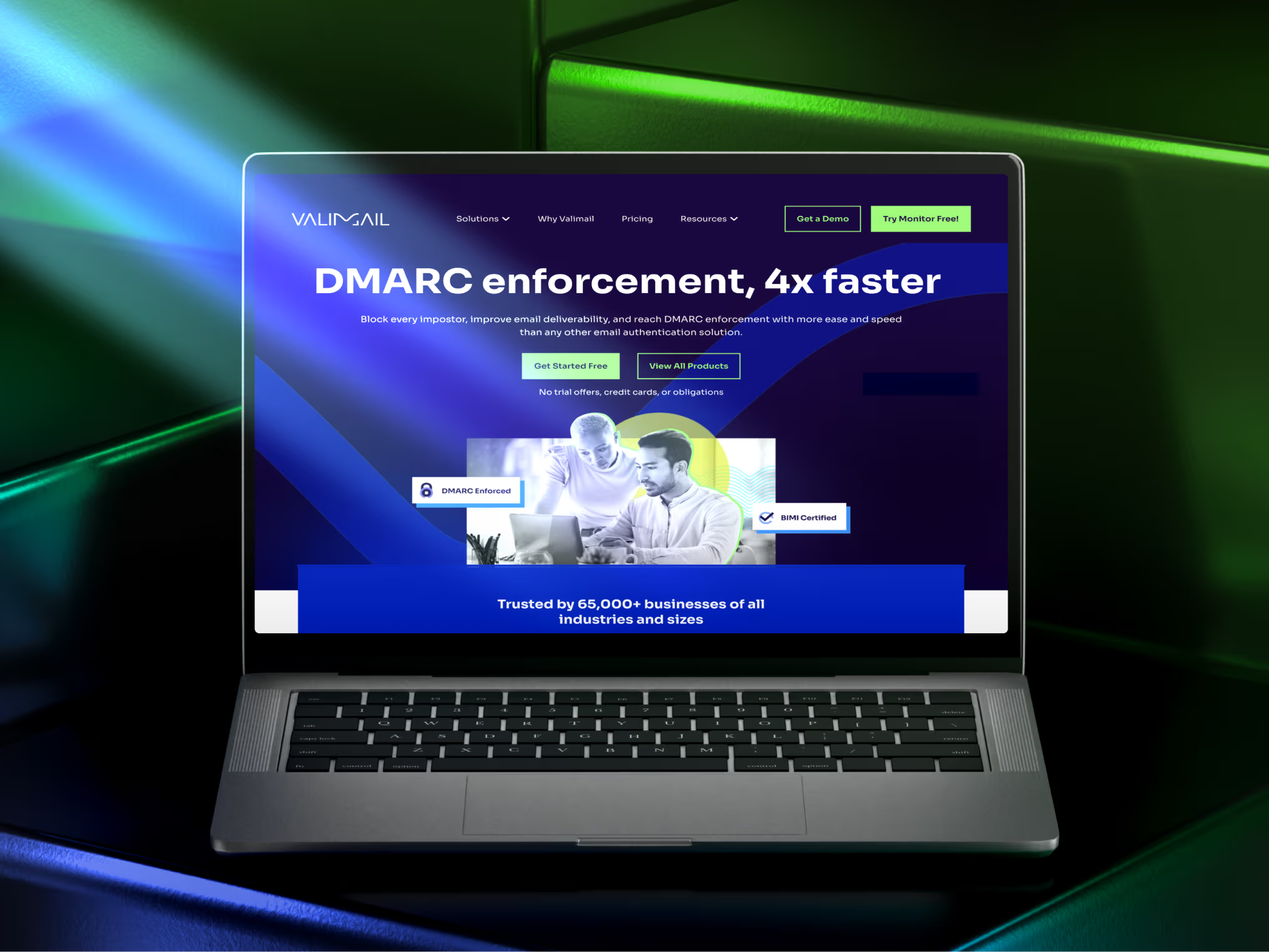
Valimail set out to improve lead quality and lower acquisition cost across Google, LinkedIn and Facebook. Tailored optimisations produced a 6.3x increase in qualified leads, a 64% lower cost per MQL and 368% more demo requests. The case study sets out what changed and why.