B2B Marketing Trends 2026: What's Actually Changing (and What to Do About It)

If your pipeline feels harder to move than it did two years ago, you're not imagining it. B2B buying has fundamentally changed. Sales cycles now average 11.5 months. Buying committees have grown to 10 or more stakeholders. And the majority of your buyers have already formed an opinion about your brand before they ever speak to a rep.
The good news? The marketers who understand these shifts and build systems around them are seeing shorter cycles, stronger pipeline, and lower CAC.
Here's what's actually driving B2B marketing in 2026, and what you can do about it.
1. Account-Based Multi-Threading Is Now a Requirement, Not a Strategy
Gone are the days of finding a single champion and riding that relationship to close. Today, 89% of B2B purchases involve multiple departments, and each of those stakeholders needs a different reason to say yes.
Multi-threading means engaging the CFO with ROI proof, the CTO and engineering team with technical fit, and department heads with day-to-day user value. All simultaneously, all with tailored messaging.
What this looks like in practice:
- Map your buying committee early. Identify 4–6 decision makers and their primary concerns
- Build role-specific content assets: ROI calculators for finance, security briefs for IT, workflow demos for end users
- Run omnichannel sequences that reach all stakeholders in parallel, not sequentially
- Track account-level engagement, not just individual lead scores
The BCG/RevvGrowth analysis of Salesforce's ABM program found 45% year-over-year pipeline growth attributed directly to multi-threaded engagement across top accounts. Single-threaded efforts increasingly fail as internal complexity grows.
2. Intent-Led Channel Diversification: Be Everywhere Buyers Research
Buyers no longer move in a straight line. They compare options across LinkedIn, podcasts, industry forums, peer reviews, and AI tools — often simultaneously. Marketers who show up only on one or two channels are invisible during the most critical phase of the buying journey.
Channel diversification in 2026 isn't about being on every platform. It's about being present where your buyers are actively forming opinions, with content that answers the questions they're asking independently.
The channel mix that's working:
- LinkedIn: LinkedIn is still the most direct path to B2B decision-makers. Sponsored content and thought leader ads are outperforming generic brand ads.
- Podcasts: 64% of B2B buyers find them valuable during early buying stages, making them the second most effective content format after case studies.
- YouTube: Citations in AI search results skyrocketed in 2025. YouTube mentions show the strongest correlation with visibility across ChatGPT, AI Mode, and AI Overviews.
- In-person events: After years of underinvestment, events rank second only to AI tools in planned 2026 budget increases. 43% of B2B marketers say in-person delivers the highest brand-awareness ROI.
- Owned media (email, newsletters): Critical for pipeline resilience as algorithm changes continue to disrupt paid channels.
Teams running diversified channel mixes report 20–30% more stable lead volume quarter-over-quarter compared to single-channel approaches. Omnichannel sequences boost open rates by 40% and meetings booked by 25%.
3. AI Search Visibility Is the New SEO
B2B buyers have shifted where they go for vendor research. They're no longer starting with a Google search, they're asking AI tools directly. And if your brand isn't showing up in those answers, you're losing deals before you ever appear in a rep's pipeline report.
AI search visibility (sometimes called Generative Engine Optimization (GEO) or Answer Engine Optimization (AEO) is rapidly becoming as important as traditional SEO for B2B brands. The brands that get cited and recommended by LLMs share a few common traits:
- Consistent earned media presence: Third-party articles, analyst mentions, and review sites that LLMs draw from.
- Strong YouTube and podcast presence: Both have the highest correlation with AI search citation.
- B2B influencer relationships: Analysts, subject-matter experts, and industry voices are increasingly the sources LLMs trust
- Structured, answer-focused content: Blog posts and resources that directly answer buyer questions at each stage.
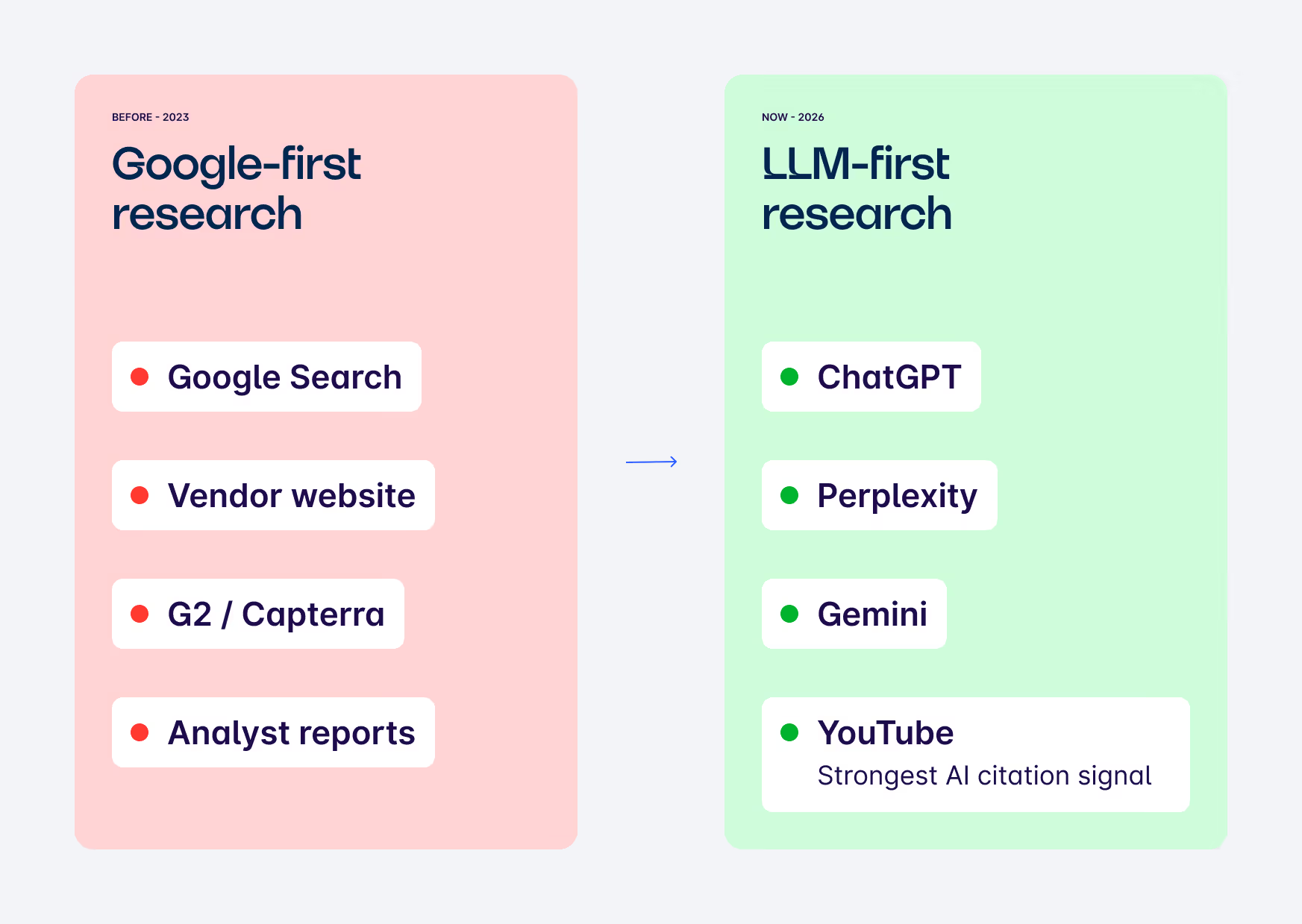
The bottom line: if your content strategy is still built entirely around Google rankings, you're optimizing for yesterday's buyer behavior.
4. Your Website Is Now Your Best (and Most Ignored) Sales Rep
The data on buyer self-service is stark and it has serious implications for how B2B marketers think about their web presence.
This isn't a minor shift in preference. It's a fundamental change in how B2B purchases happen. Buyers are completing 70% of their research before contacting sales, and they're judging your brand by the quality of that self-serve experience.
Poor website experiences like slow load times, vague value props, no self-service demos, or confusing navigation are actively killing deals before they start.
What high-converting B2B websites do differently:
- Clear, role-specific value propositions above the fold, not generic taglines.
- Interactive demos or product tours that let buyers explore without a sales call.
- ROI calculators and pricing transparency (or at least pricing frameworks).
- Case studies organized by industry and use case, not just company logo.
- Fast load times. Page speed directly impacts both conversion and search visibility.
Brands that treat their website as a sales asset are capturing pipeline from the 83% of buyers doing independent research.
5. AI-Powered Deal Velocity: Closing Stalled Deals Faster
Most B2B deals don't die because of price. They stall because of internal misalignment. The CFO wants ROI proof, the IT team wants implementation assurances, and the end users haven't been consulted at all.
AI tools are changing how marketers and sales teams address this. Generative AI can now produce transparent ROI simulations, personalized stakeholder summaries, and alignment tools that help committees reach consensus faster.
The five steps leading B2B teams are taking:
Step 1: Map every decision maker
Use LinkedIn Sales Navigator or tools like Gong to identify the 4–6 people involved and their primary concerns.
Step 2: Build personalized ROI calculators
Give finance contacts a tool where they plug in their team size and instantly see projected annual savings.
Step 3: Write role-specific outreach
Use AI to create tailored emails for CFOs, technical briefs for IT leads, and workflow-focused decks for department heads.
Step 4: Use AI on sales calls.
Real-time AI tools like Fireflies.ai surface objection-handling suggestions in the moment and generate post-call summaries tailored to each stakeholder's concerns.
Step 5: Build your first-party data foundation
Cookie deprecation and privacy regulations are making third-party targeting less reliable. Consent-based, cross-device buyer identification is becoming essential infrastructure.
The Real Challenges (and Why They're Worth It)
Multi-channel, multi-stakeholder marketing comes with genuine complexity. Attribution across long cycles with siloed data is genuinely hard. Sales-marketing alignment remains a persistent challenge. Intent data quality varies significantly across providers.
But the upside is equally real. Teams that solve these challenges report:
- 20–30% more stable lead volume versus single-channel approaches.
- 15–20% shorter sales cycles through omnichannel orchestration.
- 18% higher win rates as committees see consistent value messaging pre-decision.
- 50% more sales-ready leads through AI-powered qualification and nurturing.
The first-party data dependency is worth calling out specifically: privacy regulations are accelerating the shift away from third-party targeting. Brands that build consent-based, unified buyer data now will have a significant structural advantage within 12–18 months.
FAQs
Q: Which of these trends should I prioritize first?
A: Depends on your leak. Stalling deals? Start with multi-threading. Weak top-of-funnel? Focus on AI search visibility. Long cycles? Fix your website first.
Q: How do I get started with account-based multi-threading if I have a small team?
A: Map 4 to 6 stakeholders, note what each cares about, and create one asset per role. Run them via LinkedIn targeted by job title within target accounts.
Q: What does AI search visibility actually mean for our content strategy?
A: Be cited by sources LLMs trust: industry publications, analyst reports, G2, YouTube, and podcasts. Earn third-party mentions and publish direct-answer content.
Q: How do I prove ROI on multi-channel campaigns to my CFO?
A: Switch to pipeline influence reporting. Show which channels touched closed deals and at what stage. Clean UTMs and a solid CRM are the baseline.
Q: Is buyer self-service relevant if we sell enterprise deals over $100K?
A: Yes. 39% of B2B buyers will spend $500K+ without a rep. Enterprise buyers decide before the first call. Your website needs to earn the meeting.
Q: Where does paid media fit into these trends?
A: It is the accelerant. Multi-threading, channel diversification, and AI visibility all scale through paid. But without strong content and first-party data, returns diminish.
The Bottom Line for B2B Marketers in 2026
B2B buying hasn't just gotten more complex — it's been rewritten. Buyers drive most of the journey independently, form strong opinions before speaking to reps, and expect self-serve experiences that match the sophistication of enterprise software.
The marketers winning in this environment aren't trying to force buyers back into old funnels. They're building systems that show up across LinkedIn, podcasts, events, and AI search results. They're enabling self-serve journeys, multi-threading committee outreach, and using AI to accelerate stalled deals.






.webp)



.avif)