Generalist vs Specialist B2B SaaS Agency: 5 Key Reasons to Choose Niche
Stagnant pipelines. Missed Annual Recurring Revenue (ARR) targets. And a marketing budget that somehow keeps growing while results don't. That's the reality for 75% of B2B SaaS companies in 2026, and the wrong agency partner is quietly responsible for 20-30% of that wasted spend.
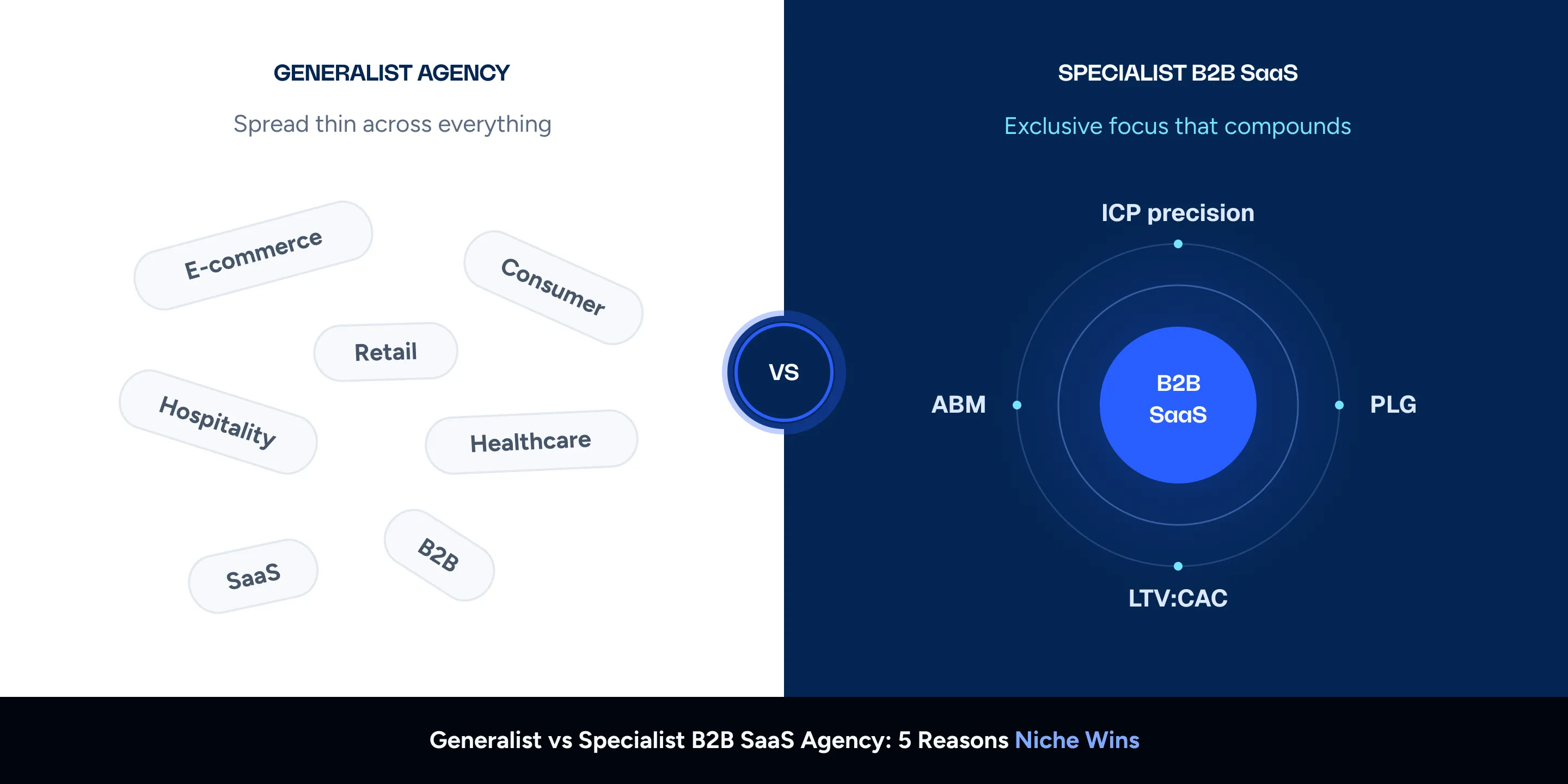
The usual suspects are generalist agencies and freelancers. Generalists pitch "full-service" solutions, but they're spread across e-commerce, retail, tech, and everything in between. That breadth comes at a cost: diluted expertise and surface-level execution for SaaS-specific needs. Freelancers look affordable until you run into their limits. Juggling multiple clients with limited bandwidth, they struggle to scale and often deliver inconsistent results. Both paths lead to the same place: slow progress and missed ARR targets.
Specialist B2B SaaS agencies are built differently. They focus exclusively on this space, and that focus compounds. Clients see 2-3x faster pipeline velocity and sustained ARR growth because the playbooks aren't borrowed from another industry. They're built for this one.
Here's why that matters.

B2B SaaS has its own rules:
- 9-12 month sales cycles.
- Buying committees of 6-10 stakeholders.
- LTV: CAC ratios that top performers hit through expansion revenue and low churn.
Generalists often recycle broad awareness tactics designed for e-commerce, ignoring realities like MQL-to-SQL gaps or product-led growth. Specialists know these nuances, from ICP mapping to cookieless tracking to multi-channel orchestration.
In this article, we're breaking down the 5 reasons niche specialists consistently outperform: deeper expertise, custom strategies, elite teams, faster results, and stronger ROI.
Reason 1: Deep SaaS Expertise Beats Surface-Level Knowledge
Generalist agencies and freelancers split their attention across e-commerce, retail, consumer, and whatever else comes through the door. Specialist B2B SaaS agencies don't. That focus creates a knowledge gap that shows up fast once a campaign goes live.
Specialists build strategies around detailed ICPs that differentiate between technical buyers like CTOs and business-focused stakeholders like Heads of RevOps. They know when a product-led growth motion makes sense for self-serve SMB users versus when a sales-led approach is needed for complex enterprise deals. They also read churn signals inside funnels, watching activation rates, feature adoption, and onboarding drop-offs. This ensures marketing is driving long-term revenue, and not just sign-ups.
Generalist agencies typically spend the first 2-3 months learning these basics. That's budget burning while they get up to speed on SaaS metrics, sales cycles, and buying committees. Freelancers lean on generic templates that skip over nuances like multi-stakeholder approval or PLG activation milestones entirely. Specialist agencies plug in with a ready-made understanding of the concepts that matter: MQL vs SQL, pipeline velocity, LTV:CAC, and expansion revenue. Meaning more of your spend goes into execution and optimization from day one. Companies using precise ICPs and SaaS-specific messaging see conversion rate lifts of 30-40% over broad targeting.
PLG vs Sales-Led Motions Mastery
Knowing which motion to run and how to market it is a big part of what separates specialists from everyone else.
In PLG models, the focus shifts to driving sign-ups, improving onboarding, and hitting activation benchmarks. High-performing teams target 20-30% of new sign-ups reaching a defined "aha" moment within the first week. Marketing, product, and success all contribute directly to revenue, so campaigns emphasize in-platform education, usage nudges, and expansion triggers.
For sales-led or hybrid motions, the playbook shifts to ABM, outbound-assist, and high-intent content designed for buying committees of 6-10 people. Specialists align campaigns with deal stages like discovery calls, technical validation, and procurement. Meaning demo-to-opportunity and opportunity-to-close rates are tracked, and the messaging gets adapted to move deals through each stage. Generalists often reuse e-commerce or broad B2B funnels that chase leads but don't support these complex, multi-touch sales paths. The result is lower close rates and longer cycles.
Churn Signal Detection and Retention Focus
Specialists treat retention as a marketing problem, not just a product or CS one. They regularly mine product data to spot churn predictors like low usage in the first 30 days, poor adoption of key features, or a drop in logins from champion users. Then, build targeted campaigns to re-engage those cohorts before they're gone. This kind of behavior-based lifecycle marketing (welcome sequences, onboarding education, upsell flows) is difficult to implement well without deep SaaS experience. It depends on understanding how product usage data links to revenue over time.
Generalists optimize for click-through rates and top-of-funnel form fills. Freelancers rarely have access to the data stack needed to see the full picture. Specialist agencies benchmark against leading SaaS players and 2026 trends. Where high-performing companies maintain net revenue retention above 110% and annual logo churn below 5% by combining strong acquisition with robust lifecycle programs. That retention-centric mindset compounds the return on every dollar invested in growth.
ICP Precision: The Specialist Advantage
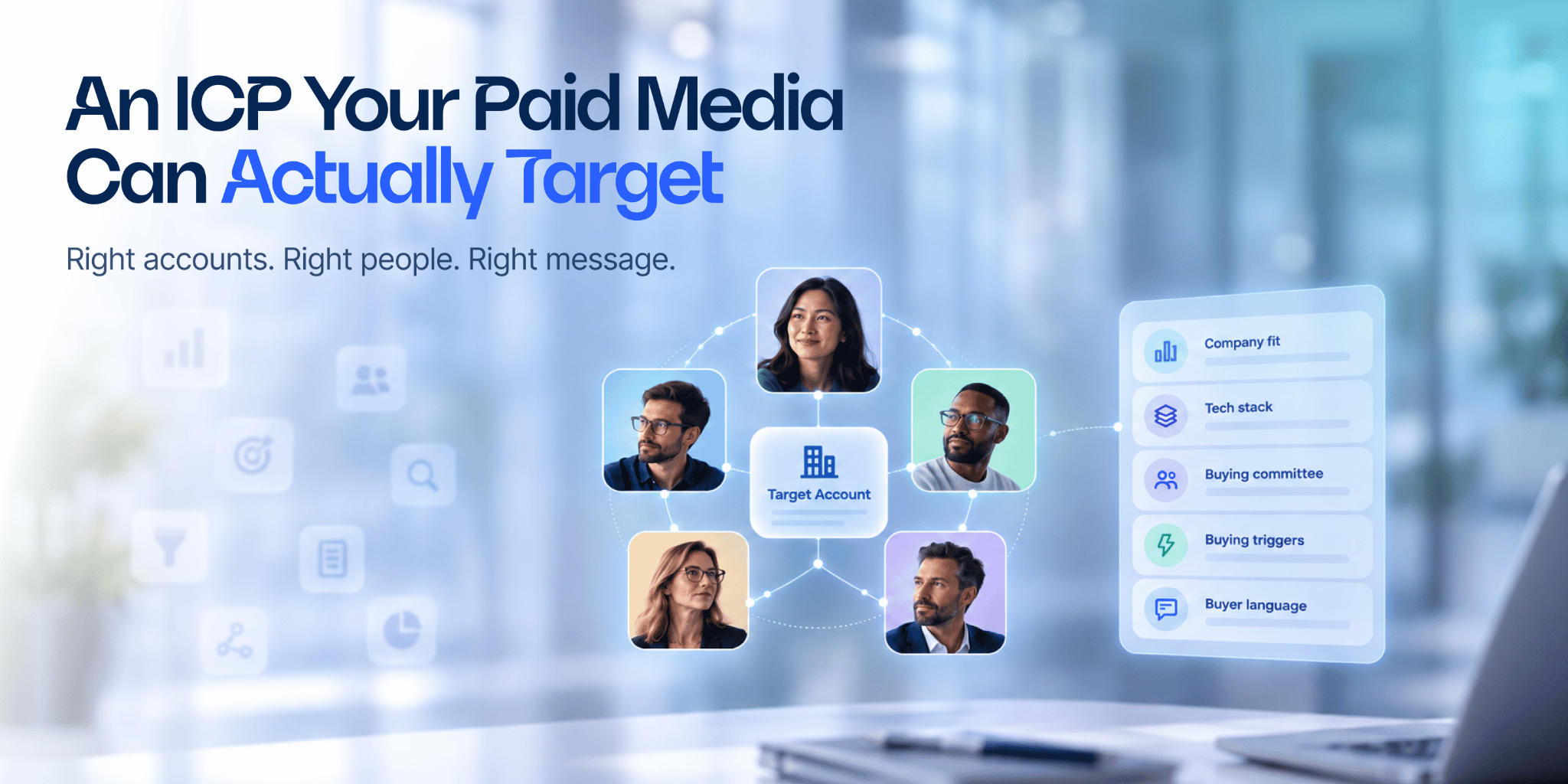
ICP precision is where deep expertise becomes visible in the numbers. Rather than a single catch-all persona, specialists map out 6-10 buyer and influencer roles within each target account. Each role gets messaging built around what they actually care about.
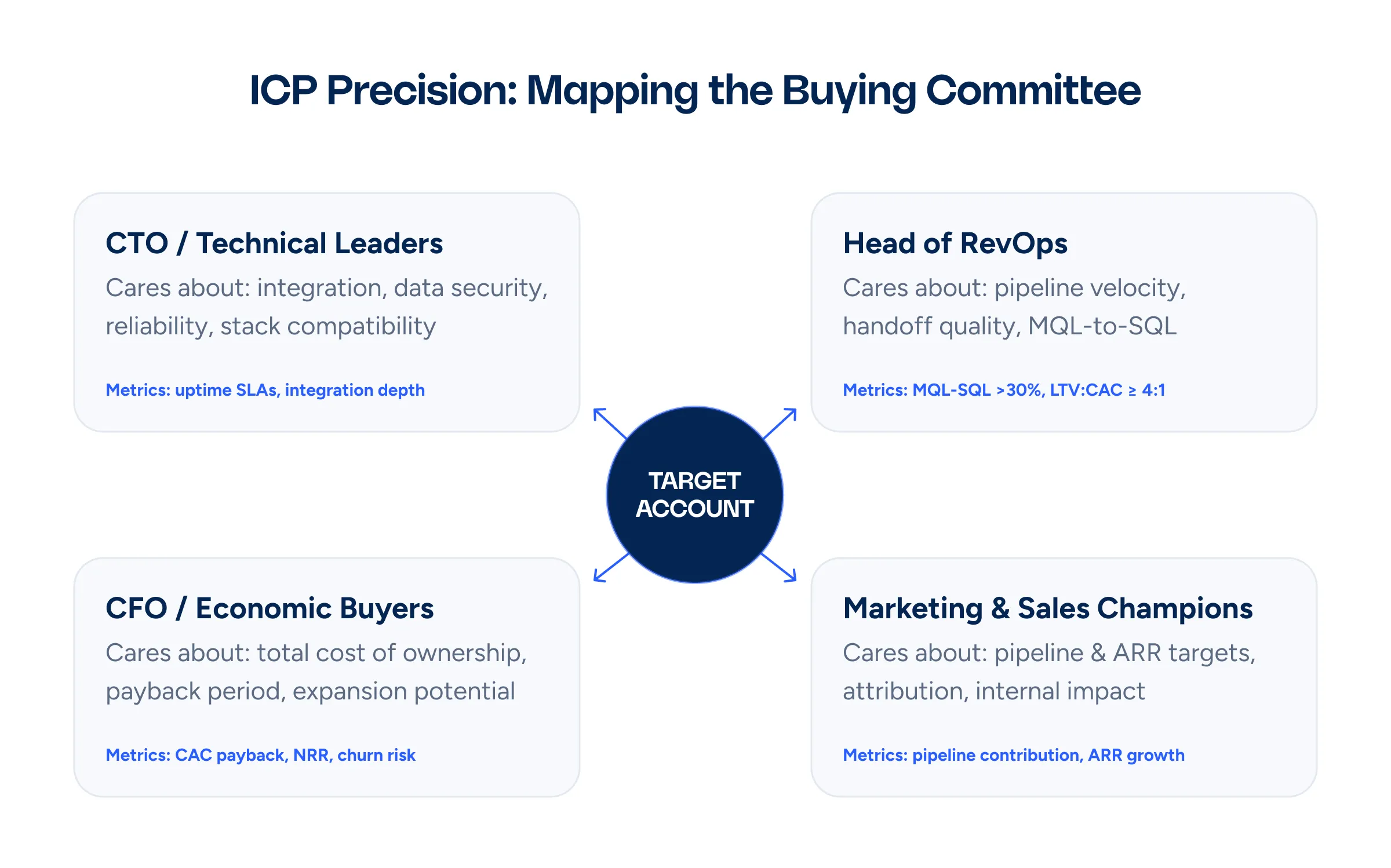
When campaigns are built on that kind of precision, the results follow. Studies show up to 3x more qualified opportunities when ICPs are narrow, data-driven, and actively used across both marketing and sales. Generalists rely on broad personas. Freelancers rarely have the resources to do full ICP research. That's why their work stays at the surface level instead of moving the numbers that matter.
Reason 2: Custom Strategies Drive Higher-Quality Conversions
Specialist B2B SaaS agencies don't pull from a template library. They build growth playbooks around your product's positioning, target segments, and revenue model. That difference matters more than most companies realize until they've burned budget on generic approaches that weren't built for this space.
Instead of recycling tactics across industries, specialists craft LinkedIn ABM campaigns targeting VP-level buyers with personalized content sequences. These strategies are designed to align with SaaS buyer psychology, addressing real objections to integration complexity, ROI proof points, and stakeholder alignment. The result is 3x higher MQL-to-SQL conversion rates compared to broad-spectrum approaches.
Generalists recycle e-commerce and consumer tactics like spray-and-pray paid search or awareness-focused socials. The problem is: those don't move B2B SaaS buyers through extended evaluation cycles. They produce low-quality leads that sales teams dismiss. Freelancers, limited to one or two channels and manual execution, can't orchestrate the cross-functional complexity required for sustained funnel performance.
From ABM to Bottom-Funnel SEO: Channel Mastery
Specialists orchestrate multi-channel strategies where every touchpoint ladders up to revenue, not just impressions. ABM programs on LinkedIn and 6sense deliver 35% average conversion lifts by serving dynamic ads to in-market accounts. SEO targets high-intent clusters like "enterprise CRM migration playbook" rather than vanity terms. Paid social runs retargeting sequences timed to sales stages. Email nurture bridges the gaps with behavioral triggers. Generalists spread thin across mismatched channels.

Zero-Party Data Nurture Sequences
Specialists capture intent through interactive quizzes, configurators, and subscriber preference pages, then feed that zero-party data into dynamic segments that trigger hyper-personalized journeys. A "build your tech stack" calculator might segment CTOs who need API docs from RevOps leaders who want pipeline dashboards. That kind of precision improves open rates by 45% and click-to-demo conversions by 28%.
2026 Cookieless Adaptations
With third-party cookies gone, specialists lean on first-party signals from product usage, CRM events, and account-intent platforms like 6sense. They optimize for privacy-first channels, including email, LinkedIn CTV, and onsite personalization.
Real Results Framework
These custom engines tie directly to LTV:CAC goals, with the 4:1 ratio as the benchmark. Specialists deliver pipeline velocity 50% faster than industry averages. B2B SaaS clients typically see demo bookings within 45 days, compared to 90 or more with generic approaches. That gap compounds into ARR acceleration that broad-spectrum marketing simply can't match.
Reason 3: Elite Full-Stack Teams Scale Effortlessly
Specialist B2B SaaS agencies field dedicated, cross-functional teams where every role is built around SaaS growth challenges. SEO experts focused on bottom-funnel keyword research. ABM specialists fluent in LinkedIn orchestration. Paid media pros who understand cookieless attribution. Content strategists writing conversion copy for 6-month sales cycles. Analysts stitching together HubSpot, HEAP, and Marketo data for full pipeline visibility. No knowledge gaps. No execution delays. Campaigns launch synchronized across channels with real-time optimization baked in.

Generalist agencies often subcontract specialists, which adds 20-30% in cost and coordination friction before a single campaign goes live. Freelancers operate as solo generalists, capped at one channel or deliverable at a time. Specialists scale campaigns from $1M ARR pilots to $50M+ enterprise motions without proportional headcount increases.
Dedicated SaaS Channel Experts
Each team member brings niche SaaS experience that compounds over time. SEO and SEM leads target cluster content for terms like "SaaS RevOps dashboards" rather than vanity keywords. ABM specialists run 1:1 personalization across 50–100 target accounts, powered by intent data. That precision drives 40% higher engagement than spray campaigns. Paid media experts optimize LinkedIn and Google for LTV-aware bidding, keeping CAC well below industry benchmarks.
Premium Tool Stack and Integrations
Specialists invest in tools generalists avoid because of cost. 6sense for account intent. Clearbit for enrichment. Marketo and Snowflake for custom attribution models. Custom integrations trigger campaigns directly from product events, like a nurture sequence that fires automatically when a trial stalls on day three. The result is faster insights and weekly pipeline dashboards that show velocity by ICP segment, not just leads generated.
24/7 Optimization Cycles
Distributed teams enable continuous testing that a single freelancer or generalist account lead simply can't match. US analysts review EMEA performance overnight. APAC paid media tweaks run while EU teams sleep. Generalists try to coordinate this through subcontractors. Specialists build it into how the team operates.
Seamless Scaling Framework
From startup at $1M ARR to scale-up at $50M and beyond, specialists add bandwidth incrementally without strategy resets. Junior ABM resources support 1:Many programs. Senior strategists step in for custom playbooks as deal complexity grows. Clients report 2x faster growth phases compared to generalist engagements that require a full pivot every six months.
Reason 4: Faster Results and Agile Trend Adaptation
Specialist B2B SaaS agencies eliminate the learning curve that costs generalists and freelancers their first quarter. These agencies launch revenue-generating pilots in weeks, not months, and deliver 50% faster pipeline velocity through pre-built frameworks and constant iteration.
The speed comes from years spent exclusively in SaaS. Specialists deploy proven playbooks, ICP-tested ABM sequences, SEO clusters mapped to buyer stages, paid campaigns optimized for LTV-aware bidding, without spending your budget on experimentation. Generalist agencies waste their first quarter adapting e-commerce tactics to 9-12 month B2B cycles. Freelancers scope projects narrowly and delay full-funnel impact while juggling other clients. Specialists hit measurable outcomes immediately: demo bookings within 45 days, SQL velocity doubling quarter-over-quarter, and ARR acceleration that compounds as campaigns mature.
In 2026's volatile landscape, specialists pivot to emerging trends without waiting for a strategy reset. These include: conversational voice search, federated learning signals, and AI-powered retargeting agents. In plain terms: search is going conversational, privacy-safe data is replacing cookies, and AI now personalizes outreach on its own. These shifts shorten sales cycles by 25% while generalists wait for quarterly reviews. Freelancers, tied to manual execution, often burn out mid-campaign. Generalists rotate in junior resources who aren't up to speed on platform changes like LinkedIn's ABM algorithm shifts or Google's Privacy Sandbox rollout.
No Ramp-Up, Immediate Execution
Day one, specialists audit your current funnel against SaaS benchmarks, including 71% YoY growth for top-quartile companies and a 4:1 LTV:CAC target, then activate pre-validated motions immediately. LinkedIn ads to in-market accounts. Nurture sequences triggered by product events. SEO targeting terms like "SaaS pipeline velocity tools." There's no 2-3 month onboarding tax. Your first pipeline report arrives in week 4, showing velocity gains versus industry averages. The industry average opportunity stage runs 3.2 months. Specialists bring it to 2.1.

Real-Time Iteration Cycles
Daily standups across SEO, paid, and content teams enable continuous optimization. Five ad variations tested overnight. Underperformers rotated by end of day. Winners scaled with 24-hour lookbacks. Generalists run monthly campaigns. Freelancers batch weekly. This velocity compounds: 35% conversion lifts in 90 days become 55% by month 6 as learnings stack.
2026 Trend Agility: Voice, AI, Cookieless
Specialists forecast and implement shifts before they become table stakes. Voice search SEO for conversational queries like "best RevOps dashboard 2026." Federated AI signals replacing third-party cookies via first-party intent platforms. Agentic personalization where AI builds 1:1 journeys from behavioral data. Generalists react after rollout. Freelancers often ignore these shifts entirely. The result is 25% shorter cycles and 2x demo volume for specialist clients.
Clients report hitting the expansion phase 2x faster, going from $1M to $10M ARR in 18 months versus 36. That's not because specialists work harder. It's because they don't rebuild engines. They refine proven machines.
Reason 5: Proven ROI, Accountability, and Reliability
Specialist B2B SaaS agencies tie every campaign to revenue outcomes. Not impressions. Not raw leads. Pipeline velocity, CAC recovery, and LTV:CAC ratios that hit the 4:1 benchmark. That commitment is built into the engagement from day one through SLAs that guarantee specific outcomes, including pipeline velocity improvements and CAC recovery within 6 months.
Generalist agencies optimize for channel-level metrics like CPC and CTR that rarely connect to SaaS revenue. Freelancers offer no formal accountability at all. In fact, 25-45% experience project churn due to bandwidth limits or scope creep. Specialists eliminate that risk with structured retainers, weekly KPI dashboards, and clear attribution models showing marketing's direct contribution to closed-won deals. The result is predictable quarter-over-quarter pipeline growth without the resets that plague generic partnerships.
Revenue-Focused SLAs and Dashboards
Specialists build SaaS-specific outcomes into the contract. Pipeline velocity targets that reduce opportunity stage time from the industry average of 3.2 months down to 2.1. SQL quality thresholds requiring 85% handoff acceptance by sales, compared to 60% for generalist leads. CAC payback recovered within 6-8 months, beating the 12-month industry average.
Live dashboards in Looker or Tableau update daily, segmenting performance by channel, ICP, and buyer role. When retargeting underperforms or ABM spikes in enterprise accounts, the team pivots immediately. Generalists report monthly totals. Freelancers send ad-hoc spreadsheets.
Anonymized Case Studies: Real SaaS Results
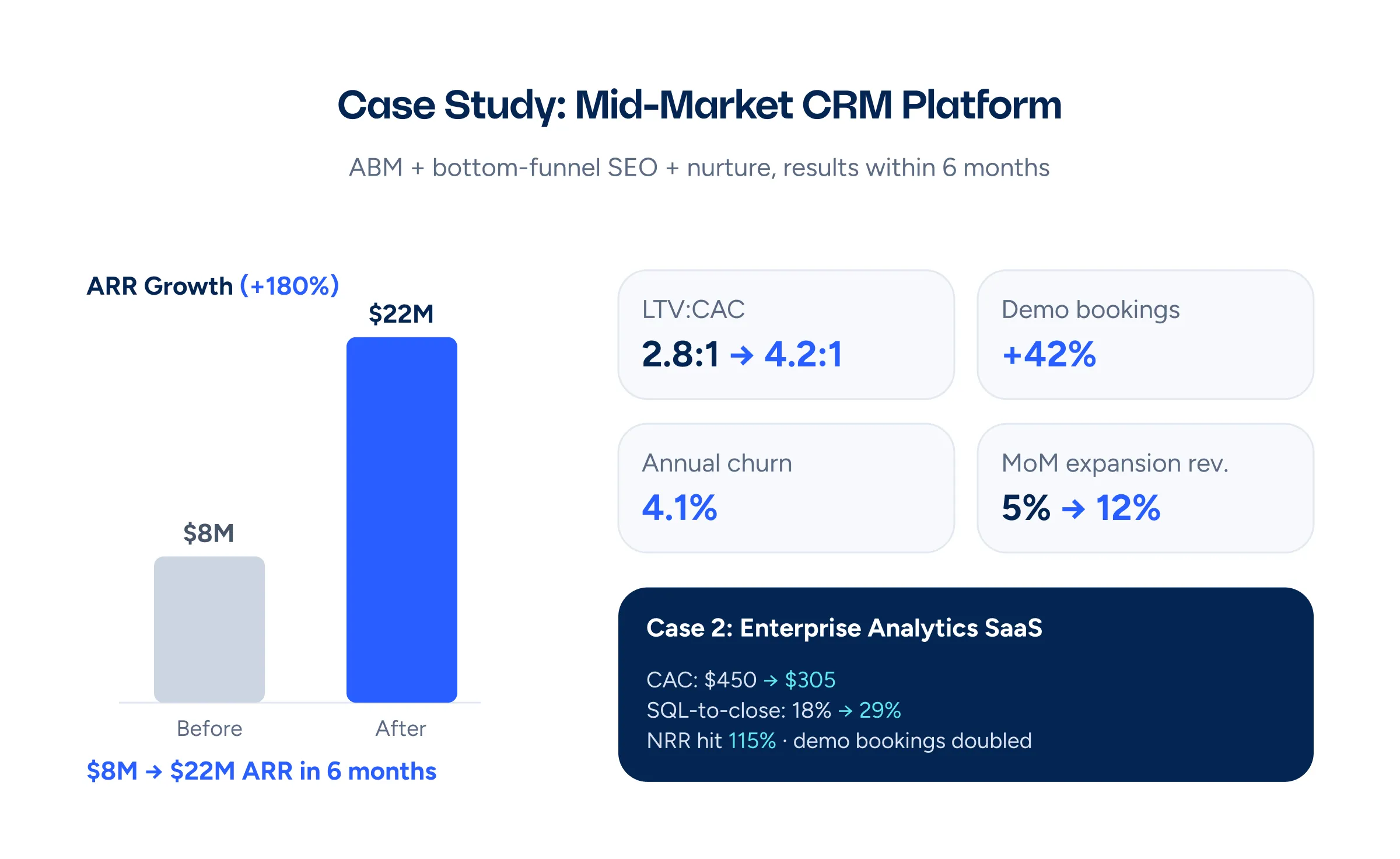
Example 1: A mid-market CRM platform plateaued at 5% MoM growth. Specialists deployed ABM combined with bottom-funnel SEO and hit 12% MoM expansion revenue within Q2. LinkedIn orchestrations drove a 42% increase in demo bookings. Nurture sequences lifted LTV:CAC from 2.8:1 to 4.2:1. Churn dropped to 4.1% annually. The business grew from $8M to $22M ARR, a 180% increase in 6 months.
Example 2: An enterprise analytics SaaS struggling with a $450 CAC. Custom ICP targeting and retargeting cut acquisition cost to $305 and lifted SQL-to-close from 18% to 29%. . Net revenue retention hit 115%. Demo bookings doubled.
Risk Elimination Framework
Long-Term Partnership Compounding
Specialists don't just run campaigns. They build compounding systems. ICP models get refined from Q1 through Q4. ABM scales from 1:few to 1:many. Product usage data gets layered into campaigns as it accumulates. Year-two clients typically see 2.5x ROI improvement as those learnings stack, creating flywheels that outpace 75% of SaaS peers still chasing volume over velocity. That's the difference between a vendor and a growth partner.
FAQs
Q: What is the difference between a generalist agency and a specialist B2B SaaS agency?
A: Generalists spread their expertise across multiple industries. Specialists focus exclusively on B2B SaaS, so they understand your metrics, buyers, and sales cycles from day one.
Q: Why do generalist agencies underperform for B2B SaaS companies?
A: They recycle tactics from other industries that don't hold up in 9-12 month B2B sales cycles, producing low-quality leads and a 2-3 month ramp-up before anything meaningful happens.
Q: When does a specialist agency make more sense than a freelancer?
A: Freelancers are a great fit for specific, contained tasks. When you need multi-channel orchestration, enterprise tooling, and full-funnel accountability at scale, a specialist agency is the better fit.
Q: How quickly can a specialist agency deliver results?
A: First SQLs typically land by week 3, with a full pipeline report by week 4. No ramp-up period.
Q: What metrics do specialist agencies focus on?
A: Pipeline velocity, LTV:CAC, SQL quality, CAC payback, and expansion revenue. Not impressions or raw lead volume.
Q: What ROI can I realistically expect?
A: Results vary, but specialist engagements have delivered 180% ARR growth in six months, 30%+ CAC reductions, and 2.5x ROI improvement by year two.
Q: How do specialists handle cookieless tracking?
They use first-party data, intent platforms like Demandbase, and privacy-first channels like email and LinkedIn CTV.
Q: What company size is this relevant for?
Any stage from $1M ARR through $50M and beyond.
The Bottom Line: Niche Wins for B2B SaaS Growth
The generalist versus specialist debate comes down to one question. Do you want surface-level execution borrowed from other industries, or SaaS-specific mastery that compounds into 2-3x pipeline velocity and real ARR growth?
The five reasons above make the case. Specialists bring deeper expertise that maps ICP precision across every role from CTO to CFO. They build custom strategies blending ABM, SEO, and nurture that deliver 35% conversion lifts. They field elite full-stack teams that scale seamlessly to $50M+ ARR. They hit measurable results fast, with first SQLs in week 3 and pipeline velocity 50% ahead of industry averages. And they back it all with SLAs targeting 4:1 LTV:CAC, with real-world results like the mid-market CRM example above proving what 180% ARR growth in six months actually looks like.
The alternative is a 2-3 month ramp-up, generic templates that weren't built for your sales cycle, and freelancer bandwidth limits that keep 75% of SaaS companies stuck in stagnation.
Your sales cycles run 9-12 months. Your deals involve 6-10 stakeholders. Your growth depends on expansion revenue and low churn. That's not a job for a generalist. Niche specialists turn marketing from a cost center into a revenue engine, and that's exactly what this space demands.