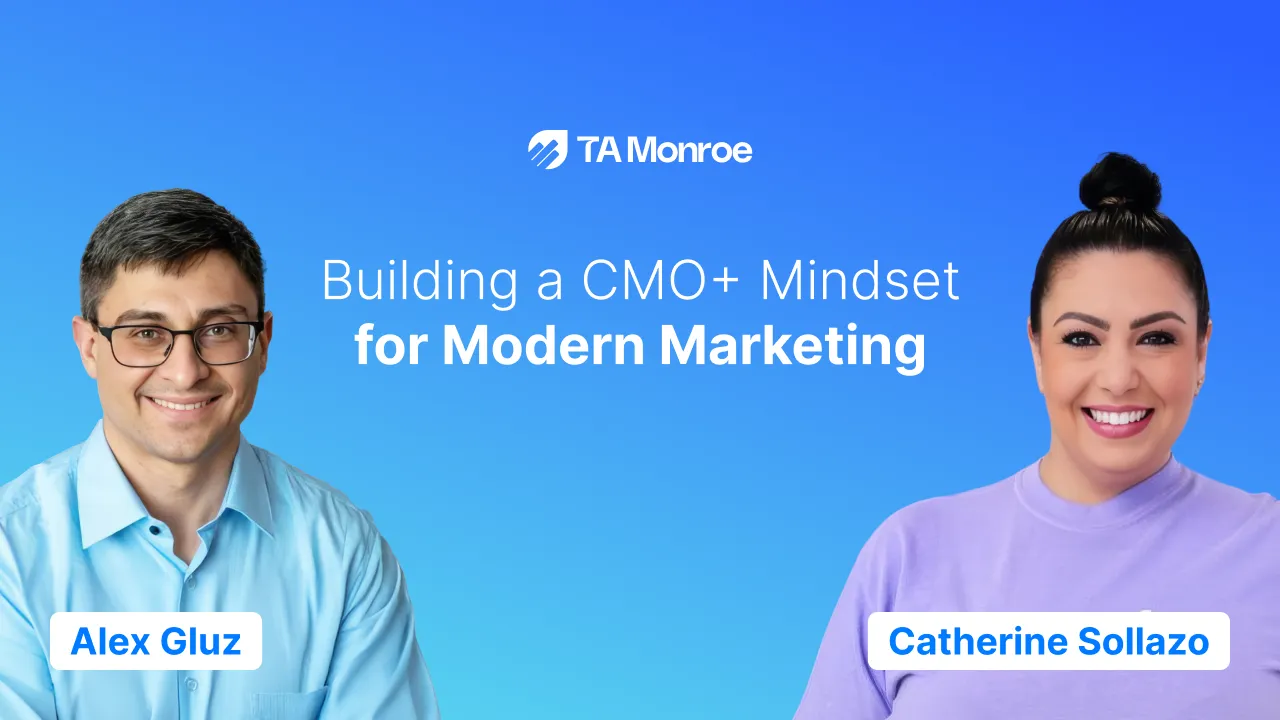
Workshop: How to Own Marketing, Product, and Partner Programs in One GTM Motion With Catherine Solazzo
About Guest
Catherine Solazzo is the Chief Marketing Officer at Appfire, a SaaS company building productivity apps for developers on platforms like Jira, Salesforce, and monday.com. In her role, she oversees marketing across brand, demand generation, technical documentation, partner programs, and customer experience. Catherine brings more than 20 years of experience across enterprise technology, developer ecosystems, and B2B go-to-market strategy, including senior marketing leadership roles at IBM and TD Synnex.
In this Workshop
Most CMOs focus on brand and demand generation. But as go-to-market complexity increases, the lines between marketing, product, and customer experience are blurring. The teams winning in this environment are the ones who own the full funnel, not just the top of it.
As a marketing leader with deep experience across enterprise technology and developer ecosystems, Catherine Solazzo explains that the CMO role has evolved well beyond traditional boundaries. Owning technical documentation, partner programs, and post-sale customer touchpoints gives marketing the context it needs to generate better pipeline, improve content precision, and stay close to the customer across every stage of the journey. The stronger approach is to get closer to the product roadmap earlier, optimize existing content rather than constantly creating new, and build a culture where sales and marketing share metrics, data, and honest feedback.
In this episode of the Revenue Engine Podcast, Alex Gluz talks with Catherine Solazzo, CMO at Appfire, about what the expanded CMO role looks like in practice, where most B2B marketing teams lose pipeline after the click, and why enablement is the most underrated growth lever heading into 2026.
Workshop Highlights:
00:50 – Catherine Solazzo's background across IBM, TD Synnex, and the developer ecosystem
02:14 – The CMO Plus model and why the role now extends into product docs and partner programs
04:21 – How a technical documentation site with over a million quarterly users becomes a pipeline asset
05:01 – What marketing teams misunderstand about their own product and how it impacts GTM strategy
07:03 – Why product marketing is the front door of the GTM org and how to involve it earlier
08:55 – Where content stops being marketing and becomes part of the product experience
10:07 – Why optimizing existing content outperforms creating new assets in a fast-moving market
11:32 – Why pipeline goes soft even when top of funnel campaigns are working
13:01 – Buyer-triggered automation and how Appfire thinks about intelligent customer interactions
14:06 – Partner program complexity and how to structure incentives in a two-tier GTM motion
18:46 – How to keep a complex GTM motion focused without losing strategic clarity
20:51 – Where sales, marketing, and CX alignment still breaks even with broader CMO scope
23:57 – Why alignment is a culture problem before it is a process or metrics problem
26:37 – How to evaluate demand gen performance across organic, paid, and partner channels
29:05 – The one growth lever Catherine is betting on for 2026
31:46 – Mentors and the operating model advice that shaped her leadership approach
Resources Mentioned
- Alex Gluz on LinkedIn
- T.A. Monroe Digital Agency
- Catherine Solazzo on LinkedIn
- Appfire
- Jira
- Salesforce
- monday.com
- Atlassian
Quotable Moments
"Churn is almost never caused by one specific thing. It's a combination of signals that matters most."
"The most dangerous finding in our report is that sentiment is a very weak leading indicator."
"Without that intelligence and timing, especially today, you're going to be falling behind."
"When you start to hit three of these different signals at one time, you know you're in deep trouble."
"If you don't know the why behind the what, then you really don't know anything."
Action Steps
- Use AI-powered customer intelligence: Analyze customer conversations in real time to identify churn risks before they become lost accounts.
- Create a single source of customer intelligence: Align sales, customer success, product, and leadership around the same customer signals and insights.
- Build playbooks for key customer signals: Standardize responses to events like executive changes, product issues, and contract requests so teams can act quickly.
- Look beyond customer health scores: Combine quantitative metrics with customer conversations to understand why accounts are at risk and where expansion opportunities exist.
- Turn customer insights into a growth strategy: Use conversation intelligence to improve customer retention, strengthen expansion efforts, and build higher-performing marketing campaigns.